dev-os

dev enviro for os

  • Highlights from the Paramedic Coordinated Bargaining Meeting and ACO Bargaining Conference

    Highlights from the Paramedic Coordinated Bargaining Meeting and ACO Bargaining Conference

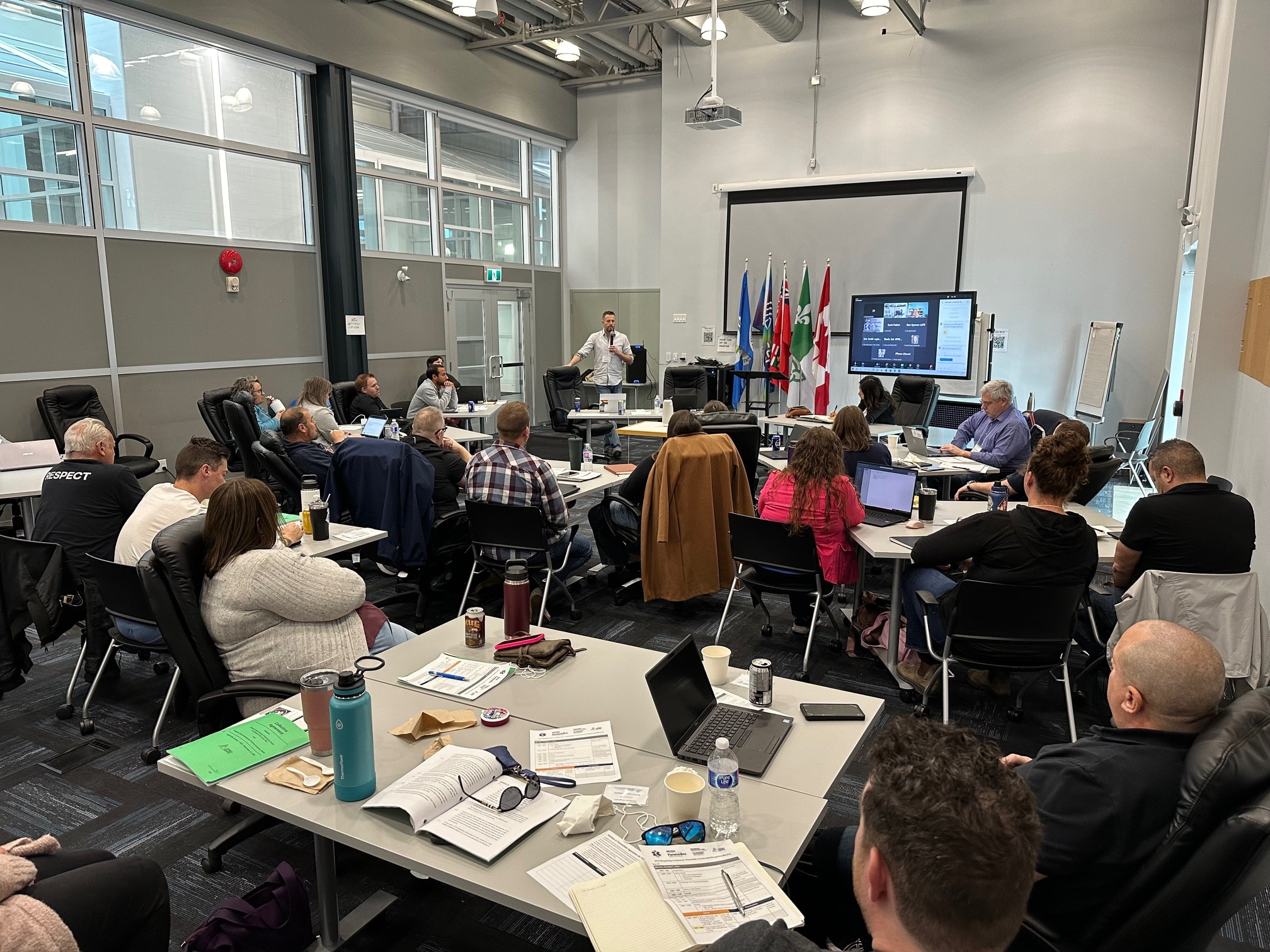
    OPSEU/SEFPO’s Sector 1 Ambulance Division hosted the Paramedic Coordinated Bargaining Meeting and the ACO Bargaining Conference at OPSEU/SEFPO Head Office on October 7 and 8, 2024.

    Bargaining teams from the Paramedic Services Locals that are expected to negotiate next year and designated Ambulance Communications Officer (ACO) delegates from both BPS (Broader Public Sector) and OPS (Ontario Public Service) bargaining units attended these events.

    OPSEU/SEFPO President JP Hornick, and First Vice-President/Treasurer Laurie Nancekivell greeted the delegates, and several OPSEU/SEFPO Executive Board Members also joined for both days.

    Important topics of discussion included: Ontario’s bargaining landscape, building strategic approaches to negotiations, contract comparison, interest arbitration, Essential Ambulance Service Agreements (EASAs), health and safety, special wage adjustment for OPS ACOs, pay equity for BPS ACOs, political action, organizing and capacity building.

    Joel Usher, Chair of the Ambulance Division, chaired the events. Staff from Contract Negotiations, Local Services, Research, Pay Equity, and Campaigns worked alongside sector leadership to make these two days a successful gathering for everyone who attended both in person and virtually.

  • Practice your French with Us by Zoom on Oct 23 at 7pm

    Practice your French with Us by Zoom on Oct 23 at 7pm

    The Provincial Francophone Committee is delighted to announce the launch of our new Zoom evening series: Practice your French with Us by Zoom !!

    Whether you’re a beginner or advanced, these evenings are designed to help improve your French skills in a relaxed and friendly atmosphere.

    Evening calendar and themes:

    • Wednesday, October 23, 2024 @ 7 p.m. – Discovery of francophone artists

    Details of the first evening:

    • Title: Practice Your French with Us – 2nd evening
    • Theme: Discovery of francophone artists
    • Date: October 23, 2024
    • Time: 7 p.m.
  • OPSEU/SEFPO seeking CAAT-Academic Retiree Volunteer

    OPSEU/SEFPO seeking CAAT-Academic Retiree Volunteer

    The Ontario Public Service Employees Union/Syndicat des employés de la fonction publique de l’Ontario (OPSEU/SEFPO) is seeking a retiree to represent OPSEU/SEFPO as a Trustee on the CAAT Pension Plan.  This Trustee position rotates between OPSEU/SEFPO CAAT Support, OPSEU/SEFPO CAAT Academic and Ontario College Administrative Staff Association (OCASA). The appointment currently held by CAAT Support expires December 31, 2024. The next appointment is to be made from the OPSEU/SEFPO CAAT Academic retiree group. The appointment has a three year term, commencing January 1, 2025 and expiring on December 31, 2027.

    The twelve-member Board of Trustees has a fiduciary responsibility to all active and retired plan members and is responsible for the administration and investments of the CAAT Pension Plan. A demonstrated ability to understand complex issues and experience in representing the interests of diverse groups is preferred.

    Experience in any of the following areas would also be considered an asset:

    • An understanding of the post-secondary education system in Ontario, the various employee groups, the industries in which participating employers operate, and the Plan;
    • Financial accounting, budgeting, and planning;
    • Pension plan design, operation, regulatory frameworks;
    • Investments, i.e., an understanding of basic investment principles, capital markets, and financial securities;
    • Labour/management relations, negotiations, and contracts;
    • Actuarial principles and concepts;
    • Governance and oversight;
    • Financial and operational risk management;
    • Information technology;
    • Strategic planning;
    • Marketing; and
    • Communications and public relations.

    The Board of Trustees typically meets seven times per year based on the following schedule:

    • Last week of February
    • Mid-April
    • Last week of May
    • Mid-June
    • Mid-September
    • Last week of November

    The CAAT Pension Plan office is located in Toronto and governance meetings are generally held in Toronto or virtually using Microsoft Teams. Travel and other expenses are reimbursed by the pension plan per plan policy. A small honorarium/stipend is provided for attending meetings to acknowledge your time and commitment.

    The successful candidate must be willing to sign a letter of understanding that requires among other things that expenses will be claimed only as per OPSEU/SEFPO policies. In addition, the Board of Trustees has established a Code of Conduct to assist Trustees in better understanding the fiduciary duties, professional, and personal standards of conduct that are expected of them. In addition to attending meetings, actively participating in meetings, and preparing for meetings by reviewing meeting materials, Trustees are expected to participate in educational activities and programs of the Board. The Orientation and Education Policy states that Trustees have a responsibility to become knowledgeable and informed about the areas relating to their position and this requires an element of self-education on the part of each Trustee. Further, to facilitate Trustees’ knowledge and skills development, Trustees are encouraged to pursue completion of an external governance program (e.g. the Chartered Director Program from Degroote School of Business at McMaster University or ICD-Rotman Directors Education Program) within their term. Education expenses will be paid and/or reimbursed based on the Education Policy for the Board of Trustees.

    To be eligible to apply for this position, you must be a CAAT Academic retiree who is receiving a pension from the CAAT Pension Plan. Candidates seeking this position should send their resume and brief cover letter by October 25, 2024 to Cheri Hearty, Supervisor, Pension & Benefits Unit. The preferred method of application is via email to chearty@opseu.org or fax to 905-712-3009. OPSEU/SEFPO strongly believes in the principles of Equity, Diversity and Inclusion and therefore should you belong to an equity seeking group, we encourage you to self identify so that this can be considered.

    If you are unable to send your application via email or fax you can mail it to:

    OPSEU/SEFPO Pension & Benefits Unit
    5757 Coopers Ave
    Mississauga ON L5C 3A7   
    Attn: Cheri Hearty, Supervisor

    Please indicate the college you retired from in your application. Please note this position is open only to those meeting the following criteria:

    1. Retired employee of Ontario colleges; AND,
    2. Member of the Academic bargaining unit at their date of retirement; AND
    3. Receiving a pension from the CAAT Pension Plan.

    The OPSEU/SEFPO Executive Board approves all OPSEU/SEFPO pension appointments. A selection committee will interview candidates and will then make recommendations to the OPSEU/SEFPO Executive Board. Interviews will take place virtually on a date to be determined. All candidates will be notified in writing as to the outcome.


  • Issue Comment: What to do with a late grievance

    Issue Comment: What to do with a late grievance

    Filed a grievance late? The Arbitrator has the power to extend the timelines

    Most, if not all, collective agreements provide a timeline within which a worker is permitted to file a grievance. Some Collective Agreement provide a generous timeline, such as 30 days in the Ontario Public Service, others as little as seven days in a few Broader Public Service locals. Regardless of the time provided, filing a grievance within the time limits will avoid a preliminary motion by the Employer to try and get the case thrown out from the very beginning, before it has a full hearing, on the basis of untimeliness.

    Employers love to file these timeliness motions to avoid the real issue and to avoid spending money and resources on litigating the case.  In a preliminary motion on timeliness they are attempting to have it dismissed in one single hearing day.

    If an Employer brings a motion that a grievance was filed past the timelines, then the Union can fight back by arguing there are reasonable grounds for extending the timelines. In most cases, Arbitrators have the power to extend timelines for filing a grievance under Section 48(16) of the Labour Relations Act which provides:

    “Except where a collective agreement states that this subsection does not apply, an arbitrator or arbitration board may extend the time for the taking of any step in the grievance procedure under the collective agreement, despite the expiration of the time, where the arbitrator or arbitration board is satisfied that there are reasonable grounds for the extension and that the opposite party will not be substantially prejudiced by the extension.”

    It is important to note that where a collective agreement states that 48(16) does not apply, the arbitrator does not have this discretion. It is also important to note that the discretion only applies when the grievance is filed late at the very beginning and does not apply to the timelines for referring the grievance to arbitration, the final stage of the grievance procedure. Arbitrators do not have the legal power to extend timeliness for late referrals.  The OPS collective agreement has a specific and rare exception to this: it explicitly says the arbitrator can forgive the late referral of the grievance.  In almost all other cases, and unless the CA has similar explicit language, a late referral is fatal for a grievance, regardless of the merits.

    What are these reasonable grounds? In the case law, arbitrators have identified a few factors they might consider when determining whether there are reasonable grounds to exercise their legal discretion. In Becker Milk Company and Teamsters Union, Local 647 (1978), 19 L.A.C. (2nd) 217 (Burkett), Arbitrator Burkett identified three factors:

    1. The reason for the delay given by the offending party.
    2. The length of the delay.
    3. The nature of the grievance.

    Building on the Becker Milk Company award, Arbitrator Schiff laid out six interrelated factors to assess extension of timelines in his award Greater Niagara General Hospital and O.N.A. (1981), 1 L.A.C. (3rd) 1 (Schiff), and which has become the key case for assessing timeliness claims in Ontario:

    1. The nature of the grievance.
    2. Whether the delay occurred in launching the grievance or at a later stage.
    3. Whether the grievor was responsible for the delay.
    4. The reasons for the delay.
    5. The length of the delay.
    6. Whether the Employer could reasonably have assumed the grievance had been abandoned

    Arbitrator Lynk further reviewed the law with respect to these factors in his award Ontario Public Service Employees Union (Robbins) and Liquor Control Board of Ontario (2015) CanLII 36165. He found that the more significant the grievance issue – such as termination for example, or serious discipline – the greater the weight given in favour of the extension. More favour is given to the extension if the responsibility of the delay wasn’t the grievor’s (for example if there were administrative errors committed by the Union). He also found that the longer the delay, the greater the onus is on the Union or grievor to provide a credible explanation, and a finding of bad faith in advancing the grievance would weigh against extending the timelines.

    A recent OPSEU/SEFPO case illustrates how these factors can be applied is Ontario Public Service Employees Union (Stanley) and Ministry of Natural Resources and Forestry (2024) CanLII 16536. Arbitrator Beatty found in favour of the Union and extended time limits after analysing the relevant factors. The grievor was employed as a pilot and placed on unpaid leave because he refused to disclose his COVID-19 vaccination status. The Employer received the grievance eight days after the established deadline in the OPS Collective agreement. First, the Arbitrator found that the delay was relatively short, which reduces any prejudice to the Employer with respect to memory for example; second, the grievor was not responsible for the delay, it was the local that was responsible for the delay; third, the nature of the grievance was serious as an unpaid leave is akin to a lengthy suspension with no definite return date; and fourth, the Employer did not allege it suffered any prejudice in being able to respond and defend itself on the grievance issue as a result of the delay.

    It is imperative that Unions are diligent in filing on time, never give the Employer a way to get the grievance thrown out before the problem for the worker is resolved. However, if a grievance is filed late, the Union may be able to defeat Employer’s timeliness motion by asking the Arbitrator to extend timelines and relieve against the delay based on the reasonable grounds reflected in the case law.


    Other Contract Enforcement Blawg posts

  • BloodLines Bargaining Bulletin: Fairness is what we’re bargaining for!

    BloodLines Bargaining Bulletin: Fairness is what we’re bargaining for!

    What are we bargaining for? Fairness!

    The OPSEU/SEFPO CBS Bargaining Team met with the employer last week on October 2 and 3, 2024 to exchange proposals and engage in discussions.

    Our proposals centred around job protection, work-life balance, and other key issues that are vital to improving working conditions and ensuring fair treatment for all of our members. That’s why the theme for this round of bargaining is “Fairness”!

    Upcoming bargaining dates:

    While we have made some progress in addressing some of these important topics, there is still more work to be done. Our discussions will continue at our upcoming meetings scheduled for the following dates:

    • December 3-4, 2024
    • January 23-24, 2025

    We remain committed to achieving the best possible outcome for you and our entire bargaining unit, and will keep you informed every step of the way.

    Your support is crucial to the success of these negotiations, and we want to thank you for your continued solidarity and support during the bargaining process.

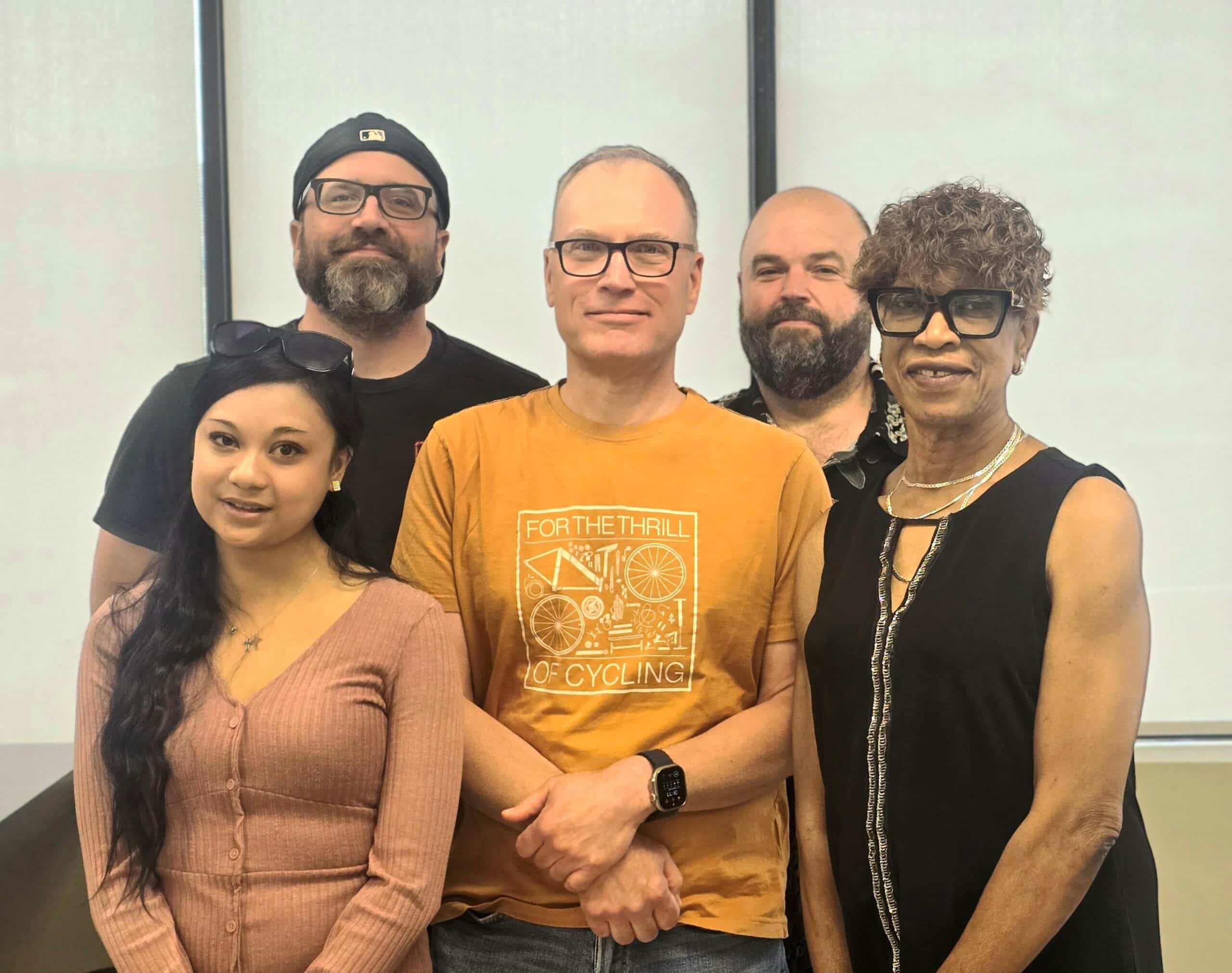
    Five bargaining team members standing together in a group

    Your bargaining team – left to right: Alexis Victoria, Alberto Alvaro, Kevin Beresten, Brent MacPherson, Audrey Smith

    Update your contact info today!

    Make sure your information is up to date so you get all the latest bargaining info. Forward this email on to your fellow colleagues if they didn’t get it!

    If you have not filled out a member application form, you can do so here: https://hub03.opseu.org/Forms/emaweb

    If you have, you can register for or update your information on the OPSEU/SEFPO Member Portal: https://members.opseu.org/

    Instructions on how to create a Member Portal account and update your info can be found here: https://shorturl.at/V9QXL

    In solidarity,
    Your CBS Support Bargaining Team:

    Alberto Alvaro, Chair – albertoalvaro@live.ca
    Audrey Smith – anmsmith@hotmail.ca
    Alexis Victoria – alexis_v99@hotmail.com
    Brent MacPherson – bgmacpherson@hotmail.com
    Kevin Beresten – kberesten@gmail.com

  • PHOLine Bargaining Bulletin – October 2024

    PHOLine Bargaining Bulletin – October 2024

    Bargaining team elected, final demands set!

    Our collective agreement expired on March 31, 2023, and the Bill 124 reopener negotiations caused a delay in getting back to the bargaining table. However, we are now ready to proceed and have secured dates in December with the employer.

    Your bargaining team has been elected!

    We will be meeting as a team in the coming months for training and to put together proposals based on the demands identified and voted on by delegates at the Final Demand Set meeting held October 5, 2024.

    OPSEU/SEFPO staff have been providing us with much-needed resources and support. Research Officer Christian Down and Negotiator Carla Carubba have been assigned to assist us in this round of bargaining.

    Update your contact info and stay in the know!

    Make sure we have your contact information so we can send you all the latest bargaining info! Please forward this email to any of your colleagues who haven’t received it.

    Here’s how to update your contact information:

    1. If you haven’t already signed an OPSEU/SEFPO card, fill out your member application form here: https://hub03.opseu.org/Forms/emaweb
    2. If you’re already a signed OPSEU/SEFPO member, register for the Member Portal to update your information here: https://members.opseu.org/

    Click here for instructions on how to create a Member Portal account and update your info: https://shorturl.at/V9QXL

    We are committed to keeping all members up to date on bargaining developments by sending regular bulletins to you via email. More information will be sent in the coming weeks and months.

    In solidarity,

    Your PHO Bargaining Team:
    Casey McGuire, Chair
    Cathy Masterson, Vice Chair
    Jason Gasgas
    Deanna Thompson
    Pak Yip

  • Sector 3 Newsletter: Boards of Education and Cultural Institutions

    Sector 3 Newsletter: Boards of Education and Cultural Institutions

    Bridging the Gap: Sector-wide Local meetings

    A strong union starts with building relationship, sector by sector – starting right here. In this spirit, the Sector 3 Executive will be organising meetings with Local Presidents. The Executive would like to hear from you to learn about your Local and your membership.

    In accordance with concerns raised at the last Broader Public Services (BPS) Conference in November 2023, your Sector Executive continues discussions on how we can better centre equity in our organizing efforts sector wide. Local discussions are an important way we can continue that conversation – look out for an invite to join us in the near future!

    Social Mapping Survey

    The Social Mapping Project (SMP) is a ground-breaking demographic survey and review of OPSEU/SEFPO membership systems launched in 2010 – the first of its kind, and an important piece of our work to strengthen our union together. It has since allowed OPSEU/SEFPO to identify gaps and barriers by providing the necessary information to ensure services meet the needs of all members.

    OPSEU/SEFPO members throughout the entire province will be asked to complete a survey to learn more about who we are and how to make our union stronger. To receive your personalized survey link, please register or update your information on the member portal.

    Register / Update your information here

    OPSEU/SEFPO has come a long way – but there is so much more to be done to make our union and our province more equitable and just. By participating in this project, you can be a part of making that happen.

    We want all our voices to be heard! For more information on how to register or update your information, click here. If you have questions that this guide does not answer, you can contact us at memberportal@opseu.org.

    Upcoming Conferences

    Bargaining Conference: The Sector is preparing for central bargaining for 2026 – look out for more information in the coming months.

    Broader Public Services (BPS) Conference: The next BPS Conference will be held November 2025 – look out for more information in the coming months.

    Bargaining News

    Art Gallery of Ontario (AGO) – Local 535

    After a historic, first-ever month-long strike – which shut down the gallery – member of Local 535 successfully ratified a new collective agreement on April 26th, 2024. The agreement opens important doors in the fight against encroaching and long-standing precarity at the gallery. The Sector was proud to see Local members shutting it down on a picket line rich with creative energy. Equally heartening was the outpouring of support from the larger membership, who stood with striking workers by walking the line, sharing social media messaging, donating to the Local, and taking the #NoDealNoAGO pledge to withdraw support from the gallery until a fair deal was reached.
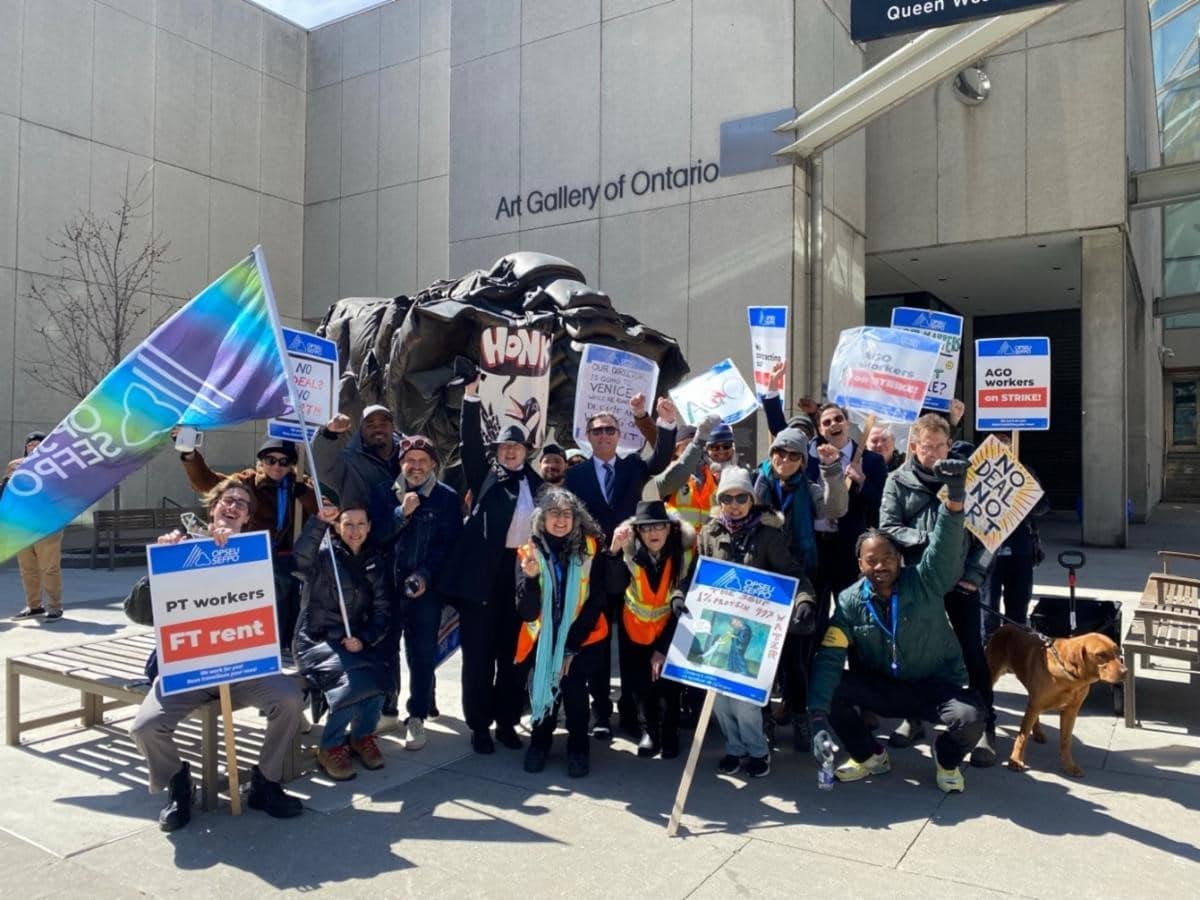

    A group of workers holding OPSEU/SEFPO flags and placards

    Full-time and part-time Local 535 members at the Harbourfront Power Plant are now in bargaining after their contract expired on May 31, 2024.

    Royal Ontario Museum (ROM) – Local 543

    Local 543 has reached a tentative agreement for its full-time members! The agreement enshrines important gains for workers, including a 9.5% wage increase over a four-year term expiring March 31, 2025, as well as a signing bonus and a 2.5% Bill 124 wage re-opener package.

    Part-time members remain in bargaining since the part-time contract expiry on March 31, 2022 – the bargaining team is making preparations for upcoming dates at the table with the employer on October 15th and 22nd.

    Ontario Council of Educational Workers (OCEW) – Update on Bill 124 Negotiations

    In December 2023, the Ministry of Education came to the Ontario Council of Educational Workers (OCEW) table and offered members a “Me-Too” agreement. The agreement set out financial increases on par with amounts awarded to CUPE education workers. Explicit in this offer was the stipulation that member unions of OCEW would have to sign away their rights to seek remedies under the constitutional challenge to Bill 124. As per our last update, OCEW opted to turn down the Ministry’s proposal to instead pursue filing a “me too” grievance.

    As you may recall, OCEW’s 2019-2022 central settlement contained a “me too” provision stipulating that if any other education worker central tables, such as OSSTF and ETFO, were awarded greater wage increases than OCEW for the 2019-22 period, such increases must also be provided to OCEW education workers.

    Over the last several months, OPSEU/SEFPO has met with the Crown and the Council of Trustees’ Association (CTA) regarding the remedy for Bill 124. On May 22, 2024, OPSEU/SEFPO met with our OCEW affiliates to review a tentative agreement proposing to settle the “me too” grievance and signed a Memorandum of Settlement on June 19, 2024.

    In accordance with this MOS, payments are to be dispersed by October 15, 2024. Members who may have worked during the moderation period but are no longer employed are still eligible for receiving retroactive pay – please contact your employer to make arrangements.

    It’s been a long and arduous process – and we can thank the Ford government, enacting three years of unconstitutional wage suppression while public service workers struggled through a global health crisis. The Sector Executive extends its thanks to the tireless work of OCEW affiliates as well as OPSEU/SEFPO members and staff in getting members their just monies!

    Reminder: Sector Dues

    Reminding Locals to please pay your Sector dues: your dues help to cover the costs of promoting Sector activities and the important work we do in our teaching and learning environments. Please look for the invoice and reminder sent to you by Sector 3 Treasurer, Donna Caissie.

    Congratulations to our Sector Executives: Awards and Appointments

    Congratulations are in order for Sector 3 Executive members and the array of new awards and appointments:

    Melody Hurtubise, Sector 3 Executive Acting Chair

    We celebrate Local 2100 President and Sector Acting Chair Melody Hurtubise, winner of the Leah Casselman award for “Mobilizing” at Convention 2024.

    Kelly Martin, Region 3 Executive Board Member

    Congratulations to Kelly Martin, Sector 3 Executive Member at Large, on her appointment as a Region 3 Executive Board Member.

    Bonnie Eddy, Region 3 Provincial Women’s Committee Representative

    Lastly, congratulations to Bonnie Eddy, Sector 3 Executive Member at Large, on her appointment as the Region 3 Provincial Women’s Committee representative.

    Follow us on Facebook!

    Follow us on Facebook to stay up to date on what’s happening in OPSEU/SEFPO Boards of Education and Cultural Institutions – Sector 3!

    In solidarity,

    Your Sector 3 Division Executive

    Sandra Cadeau, Chair

    Melody Hurtubise, Acting Chair

    Susan Richarz, Secretary

    Donna Caissie, Treasurer

    Rebecca Bailey, Member at Large

    Kelly Martin, Member at Large

    Bonnie Eddy, Member at Large

  • Student and Faculty Futures, Together: Responding to Student Concerns About Potential Strike Action

    Student and Faculty Futures, Together: Responding to Student Concerns About Potential Strike Action

    Printable PDF

    As the workers in college classrooms, laboratories, libraries, and offices working directly with students, we know that our working conditions are student learning conditions. The idea of labour action can be stressful for students – it’s important that we respond to student concerns, demystify strike mandate votes/strikes, and bring them on side as allies in our fight. Here are some common questions you might receive from students, and suggested ways to respond:

    Are you going on strike?

    • Whether we go on strike or not depends on the CEC and the Colleges. Your education is our livelihood, and we take it very seriously. As long as productive negotiations (“bargaining”) are ongoing, we will continue to work towards an agreement.
    • A strike mandate vote doesn’t automatically mean you’re going on strike. Employers have a lot of legal advantages over their employees and decide important parts of your working conditions, such as hours of work and pay. Unionized workers can call a strike mandate vote only once during bargaining.
    • A strike mandate vote authorizes our elected bargaining team to call a strike if necessary. The credible threat of labour action authorized by a strike vote is the most important legal tool at our disposal to pressure the employer to bargain fairly.
    • A strong, high-participation strike vote shows that over 15,000 faculty members across Ontario are united in our demands. This gives us power at the negotiation table, so you’ll see a lot of communication about the strike vote!
    • Faculty don’t want to strike: we love our work, and we want to be in our classrooms, laboratories, libraries, and offices working with
      • A strike will disrupt our lives just as much as it disrupts your education.
      • A strike is a sacrifice for a better contract, not a holiday – the employer withholds payment and we risk financial hardship while balancing bills.
      • If faculty strike, it is not a decision made lightly – but a necessity we were forced into by the Colleges.

    How does this affect me?

    • Our employer – the Colleges, through the College Employer Council (CEC) – want to make it harder for college faculty to have good, stable jobs – and it impacts your education.
      • Faculty haven’t seen meaningful increases to the amount of time they can spend on student evaluation and feedback since 1985 – five minutes per student, per week is not enough!
      • 14 out of 24 colleges no longer have librarians.
      • Many colleges no longer have student counsellors – during a province-wide student mental health crisis.
      • Colleges are spending money on more managers, new buildings, and vanity projects to attract investors and business sponsors – while the essentials, like student accommodation and mental health supports, are cut back.
      • The employer is pushing a definition of “teaching” which only focuses on classroom time, and not the range of supports that you need to succeed.
    • A College system where profits are prioritized over quality education hurts all of us. We’re invested in a better system for students and faculty. The Colleges are pushing forward a corporate model of education that doesn’t centre your experience – but are more than happy to take your money!
    • Regardless of the story they tell, the Colleges have money to invest in education – in the last year alone, the Colleges have accumulated a surplus of $1 billion. There’s more money for managers, but three-quarters of teachers, counsellors, and librarians working in Ontario colleges are on short-term contracts with little to no benefits or job security.
    • Your tuition and fees should fund a better system. We’re asking the CEC and the College Presidents to invest in your learning conditions, which are our working conditions.

    Why is this happening?

    • We came prepared to reach a fair contract before our contract expiry on October 1, 2024. An agreement could not be reached because the employer’s proposals are pushing “concessions” on us: in other words, asking that we give up rights and protections related to our working conditions that workers have won in previous years.
    • We don’t accept concessions because the rights we’ve won in the past are not ours to give away. Accepting concessions means going backwards. All worker protections in our collective agreements – our contracts – were fought for by workers that came before us. This is the same for many things workers appreciate today: workers organized into unions had to fight to secure things like weekends, breaks, vacation, 8-hour work days, minimum wage, paid sick time, benefits, maternal/paternal leave, and so much more.
    • Our responsibility to each other as a work force is to bargain a contract that takes us forward: fighting for changes that will improve quality of education, help us keep up with the rising cost of living, and adapt to changing conditions in the Colleges.
    • Our goal remains a fair, negotiated agreement – and we remain hopeful that the Colleges will step up with fair agreement and avert a strike.

    What about my grades?

    • In the event of a strike, we will work with the Colleges to develop a student-centered success plan upon our return.
    • This puts that decision about your grades largely in the hands of the CEC and the Colleges – as long as they negotiate fairly, we will continue to bargain.

    Will the semester be extended?

    • This is entirely up to the CEC and the College Presidents who administer the College semester.
      • If there is more content that needs to be completed than there is time in the semester, it’s possible that the semester might be extended. In the 2017 work stoppage, the fall semester was extended into January.

    How can I support faculty?

    • In the event of a strike, student solidarity can help strengthen its impact. The stronger a strike, the higher the likelihood it will be a shorter one.
    • Students are encouraged to email concerns to their College President now to help us build pressure and reduce the risk of a labour disruption this semester.
    • If the time comes when the Colleges fail to negotiate fairly and force a strike – join our picket line!

    FAQs for students

    Downloadable FAQ for students

    Our working conditions are your learning conditions – we’re fighting for better!

  • RSVP: Phone Banks for Quality Education!

    RSVP: Phone Banks for Quality Education!

    Student and faculty futures are on the line.

    We’re making calls to encourage members to vote YES for a strike mandate next week!

    We’re holding our strike vote from October 15-17. With your help, we can make it historic.

    We’ll be making hundreds of phone calls every day to make sure we talk to every College Faculty member about the importance of voting YES and to get the biggest turnout possible.

    It shouldn’t be getting harder for College Faculty to have good, stable jobs. Yet the Colleges are ready to sacrifice quality education by making it even harder: pushing concessions that will increase precarity, job instability, and our workload.

    To show the Colleges that we won’t back down when it comes to student and faculty futures, we need every member to vote YES.

    We can’t do it alone. We need you to take part in making these calls and having these conversations.

    We’ll be meeting on Zoom and using CallHub to make calls in shifts. It’s an easy tool: we’ll show you how and run through how to talk to members!

    Commit to dropping in when you can, as many times as you can, and stay as long as you can. It’s all hands on deck!

    RSVP:

  • Vote YES Because Quality Education Matters: Bargaining Update

    Vote YES Because Quality Education Matters: Bargaining Update

    Bargaining Bulletin 10

    It shouldn’t be getting harder for College Faculty to have good, stable jobs. Yet the Colleges are ready to sacrifice quality education by coming after student and faculty futures.

    Today, we were back at the bargaining table and preparing for our first day of conciliation tomorrow. Despite the employer’s inconsistent “commitment” to bargaining a negotiated settlement, we remain focused on our goal: advancing member demands – brought to the table through our democratic processes – and fighting off dozens of serious concessions.

    Concessions tabled by the CEC and the Colleges include:

    • Introducing new layoff provisions, increasing job instability;
    • Extending the academic year to 12 months for everyone, posing risks to our vacation blocks, 11th month overtime provisions, and non-teaching periods (11.08);
    • Two-tiering workload protections, targeting faculty already facing inequitable workload pressures – including members in academic upgrading and trades;
    • Reducing teaching time (e.g. asynchronous course teaching contact hours) with serious implications for workload and Partial-Load faculty seniority and status;
    • Introducing a new probationary period for Partial-Load faculty – upwards of 2 years – creating new barriers to job security;
    • Removing five (5) consecutive professional development (PD) days and further restricting, reducing, directing and controlling our access to PD.

    Starting October 15, vote YES for a strike mandate – because quality education matters. An overwhelming YES vote will send a strong message to the Colleges that we are united behind our demands.

    Faculty need a contract that carries us forward

    The CEC and the Colleges are tabling no less than 30 concessions, with serious implications on faculty experiences going into the future.

    The supposed efforts to “modernize” the academic year – extending it to 12 months – and create “flexibility in scheduling of high demand programs such as apprenticeship” rolls out the red carpet for the employer. The Colleges already have the ability to operate year round, and to compensate members for their work through the 11th month provision (15.01 B).

    In reality, extending the academic year is a grasp for academic control: further constraining professional development in 11.08 periods, reducing the need for the 11th month, and further impacting teaching contact hour thresholds, and sessional rollover.

    In addition, the CEC’s proposed “modes of delivery” definitions do not accurately represent what teaching entails. What they do is allow the CEC to actually reduce the recognition of the time involved in teaching: setting up a “bait and switch” scenario on the SWF without actually implementing the neutral chair’s recommendations from the Workload Task Force Report.

    As wage gaps continue to widen while we struggle with affordability and inflation, the employer’s monetary package amounts to real time wage cuts, not gains. If the CEC honours the core mandate of the Colleges – to train Ontario’s future workforce and support student experiences – they would invest in quality education. The Colleges have money to make that commitment, with an accumulated system surplus in the billions. There’s money in the system to prioritize quality education. Nonetheless, we have indicated that we are ready and willing to work with the CEC to navigate uncertainty in the future.

    From October 15-17, vote YES for a strike mandate to support the core mission of Ontario’s public colleges: teaching, learning, and student support. Remember: we get the contract we are all willing to fight for!

    In solidarity,

    Your CAAT-A Bargaining Team:

    Ravi Ramkissoonsingh, L242, Chair (he/him)
    Michelle Arbour, L125, Acting Chair (she/her)
    Chad Croteau, L110 (he/him)
    Bob Delaney, L237 (he/him)
    Martin Lee, L415 (he/him)
    Sean Lougheed, L657 (he/him)
    Rebecca Ward, L732 (she/her)

    Stay Informed, Stay Engaged, Get Involved

  • Ford government’s audit of child protection system another smokescreen to evade responsibility for mounting crisis in child protection sector

    Ford government’s audit of child protection system another smokescreen to evade responsibility for mounting crisis in child protection sector

    This is a joint release with CUPE Ontario.

    TORONTO – Thousands of young people in Ontario have been warehoused in hotels, motels, office buildings and worse because of an acute crisis of care the provincial government has manufactured. Four years into a “redesign” of the province’s children’s aid system, with no progress to show for its efforts, it’s clear the announced audit is another smokescreen to distract from the government’s abject failure to support children and families while opening the door for more privatization in the sector.

    “It’s the 11th hour of this crisis and this government has yet to do anything to solve it. Workers, advocates, and families have been sounding the alarm about challenges they face trying to keep children and young people safe for years. That Doug Ford is trying to lay blame on individual agencies shows just how insincere he is,” said Fred Hahn, President of CUPE Ontario which represents roughly 5,000 child protection workers working at 27 Children’s Aid Society (CAS) agencies across the province. “This government has had every opportunity to prove they care about children. They have shown, time and again, they don’t.”

    In 2020, the Ford government instituted an “overhaul” of child welfare, signaling a shift in provincial priorities towards more resource-intensive early intervention work that aims to keep families together. Funding did not follow this reorientation with roughly 90 per cent of agencies currently running financial deficits in the millions, leaving the workers to shore up dangerous gaps amidst ongoing layoffs and service restrictions. The Financial Accountability Office released a report in June that indicated funding for child protection has fallen well behind inflation, with the sector missing $70 million compared to where it was when Ford took over.

    “Workers are already worked to the bone, with CAS agencies stretching to fill service gaps exacerbated by this government’s gutting of social services as a whole,” said JP Hornick, President of OPSEU/SEFPO which represents an additional 3,200 child protection workers across 13 agencies. “The solution has always been to adequately fund the system so that the most vulnerable youth in our communities can receive the supports they need. It’s a low bar, and still the Ford government cannot clear it.”

    Ford’s recent claim that people are getting rich off child protection work is correct – except it’s not workers or management enriching themselves, it’s parasitic for-profit group home operators that charge exorbitant fees to desperate CAS agencies because of rules created by this government.

    “We need to end the for-profit models in all residential care facilities, and introduce province-wide licensing of group homes, to ensure our services place children at the centre of care,” added Hornick. “There’s so much about the current system that is antiquated. Ontario’s current funding formula partially ties agency funding to the number of kids in care. Our members at the Sarnia-Lambton CAS – who are focused on keeping kids in the home and with their families – have seen their annual budget alone decline by over $1 million over the last decade.”

    While workers and advocates call for change, this government – and governments before it – have systemically ignored recommendations from every coroner’s inquest. If the province was serious about putting kids first, Ford would instruct his Ministry to start with the hundreds of recommendations already in hand – or he’d reconstitute the Office of the Child and Youth Advocate that his government shuttered because they could not stand withering criticism of their failed policies.

    “It’s clear they raise the spectre of this promised overhaul to silence critics but they have no intention of following through in good faith. That’s what makes Ford’s words so maddening,” said Hahn. “But I know Ontarians can see right through him. Ontarians know he’s flailing, desperate to quiet a story that reveals another layer of shocking apathy and mismanagement by his government. The fact remains that child protection workers have been put in an impossible situation, trying to keep young people safe with ever dwindling resources. My gratitude goes out to them every single day.”

  • Job Opportunity – Human Rights Officer – 24.041

    Job Opportunity – Human Rights Officer – 24.041

    Title: Human Rights Officer (45-02)
    Location: Member Equity Unit, Local Services and Member Organizing Division, OPSEU/SEFPO Head Office, 100 Lesmill Rd, Toronto, ON M3B 3P8
    Reporting to: Supervisor, Member Equity Unit
    Search Type: Open to all OPSEU/SEFPO members
    Salary: $1,994.00 to $2,215.00 per week (Range 4 – Pro-Tech)
    Working Conditions: As provided in the OPSSU/OPSEU/SEFPO Collective Agreement

    Principal Duties:

    Provide support and advice to OPSEU/SEFPO staff and members on Equity/Human Rights-related issues:

    • Takes lead role in the project management and delivery of the Dismantling Systematic Racism Program (DSRP), including the initiation, planning, execution, monitoring and control, and closure stages
    • Provides support and advice to assigned Equity Committees
    • Administers and advises on the Harassment and Discrimination Prevention Policy
    • Provides research, policy and administrative support to OPSEU/SEFPO’s Equity Committees and Caucuses and OPSEU/SEFPO’s representatives on outside committees and subcommittees; represents OPSEU/SEFPO as committee member where necessary
    • Acts as an advocate on behalf of members on Human Rights and related issues, excluding any issues relating to complaints under OPSEU/SEFPO’s Harassment and Discrimination Prevention Policy or Personal Harassment Policy
    • Advises staff on issues regarding Human Rights and related issues
    • Plans and coordinates conferences and workshops on Human Rights and Equity-related issues
    • Prepares educational materials on racism, family-work issues, accommodation issues, Human Rights and Employment Equity with the assistance of the Education Unit
    • Analyzes and advises on legislation and regulations on Human Rights and related issues
    • Develops educational programs for HDPP advisors and investigators
    • Promotes accessibility of OPSEU/SEFPO to its membership through alternative formats, principles of accommodation, and administration of the accommodation fund
    • Performs other related duties as assigned

    Qualifications:

    • Undergraduate degree and four years of related work experience (or equivalent combination of education and experience)
    • Knowledge of applicable Human Rights legislation, policies, theories and principles
    • Knowledge of Human Rights case law
    • Knowledge of OPSEU/SEFPO Equity Committees and Caucuses
    • Project management skills and experience
    • Knowledge of and experience in developing and delivering adult education courses
    • Knowledge of OPSEU/SEFPO organization, structure and policies
    • Understanding of and commitment to labour movement and social democratic philosophy
    • Understanding of and commitment to the principles of anti-racism, equity, diversity and inclusion
    • Requires intermediate PC skills and knowledge of relevant software packages
    • Requires tact and diplomacy skills

    OPSEU/SEFPO supports employment equity. Racialized workers, women, Indigenous workers, LGBTQ2S+ workers and workers with disabilities are encouraged to apply. For the purpose of statistical data collection, applicants are strongly encouraged to voluntarily self-identify. OPSEU/SEFPO’s diverse workplace also supports Francophone workers and young workers.

    A total of 60% or greater must be achieved in the competition process to obtain the position.

    Please advise should you require any accommodation to participate in this competition.

    Expression of Interest – 2-step process:

    1. Submit your resume with cover letter in Word or PDF to competitions@opseu.org quoting “24.041 – Human Rights Officer (45-02), Member Equity Unit” by 5:00 pm (Eastern Time) on October 23, 2024;
    2. Complete OPSEU/SEFPO Job Applicant Survey – Please click the link below: https://forms.office.com/Pages/ResponsePage.aspx?id=ntqy3vmHp0WKvIeSS54XACSzxUJfqY5Ehbkv7jfWaYpUQlNHQk04SzhKSzFQNVVNUVVWVDZNNTE5SCQlQCN0PWcu

    To be considered in the job competition, it’s essential to complete both steps of the two-step submission process. Failure to do so may result in disqualification from consideration.