In commemoration of the eleventh anniversary of the passing of the inspirational leader Nelson Mandela, OPSEU/SEFPO’s Coalition of Racialized Workers and Rainbow Alliance Arc-en-ciel would like to invite you to a free Zoom webinar, where we are pleased to host guest speaker, the Honorable High Commissioner of South Africa, Mr. Rieaz Shaik.
High Commissioner Rieaz Shaik is South Africa’s envoy to Canada since 2022. Mr. Shaik is an anti-apartheid activist, a former student leader, and an active member of African National Congress’s (ANC). He has held several senior management positions, both in the private and public sectors, including CEO at CorpAfrica (Pty) limited, South Africa’s Consul General to Germany, South Africa’s Ambassador to the People’s Democratic Republic of Algeria, Special Advisor to the Minister of Foreign Affairs, Head of South Africa’s foreign intelligence service, and Group Executive of the Development Bank of Southern Africa.
The webinar will shed light on the South African struggle against apartheid, their path to freedom, leadership of Nelson Mandela and the current South African court case in the International Court of Justice.
After the talk we will have a virtual screening of the film “Road Map to Apartheid”.
The film was produced in 2012 and has won multiple renown awards including:
The Garden State Film Festival: Best Documentary
The Milan International Film Festival: Best Editing Winner – Excellence in Documentary
IndieFest: Film Heals Award
Official Selection: Manhattan Film Festival
Hot Springs International Documentary Festival
Official Selection: Docutah International Film Festival
Official Selection: Durban International Film Festival
Register here for the December 11 webinar from 6:30 PM to 8:30 PM
In Solidarity,
OPSEU/SEFPO’s Coalition of Racialized Workers (CoRW) and Rainbow Alliance arc-en-ciel (RAA)
This year’s event is in memory of the late artist Carole Condé (June 27, 1940 – July 19, 2024), one of Mayworks’s founders who was dedicated to building an art practice centered around revolutionary social change. All proceeds from the event (including ticket, silent auction, and bar sales) go to Mayworks’ new program, the Conde & Beveridge Labour Arts Residency.
OPSEU/SEFPO Art Gallery of Ontario workers to receive Traditional Labour Arts Award
After a month-long strike with a picket line that attracted widespread attention and media coverage because of their artistic creativity, Art Gallery of Ontario (AGO) workers from OPSEU/SEFPO Local 535 will be presented with the Traditional Labour Arts Award for their artistic approach to labour action during their strike. AGO workers harnessed their artistic power on the line in March and April of 2024, with performance art, videos, costumes, and many picket signs that were themselves original works of art!
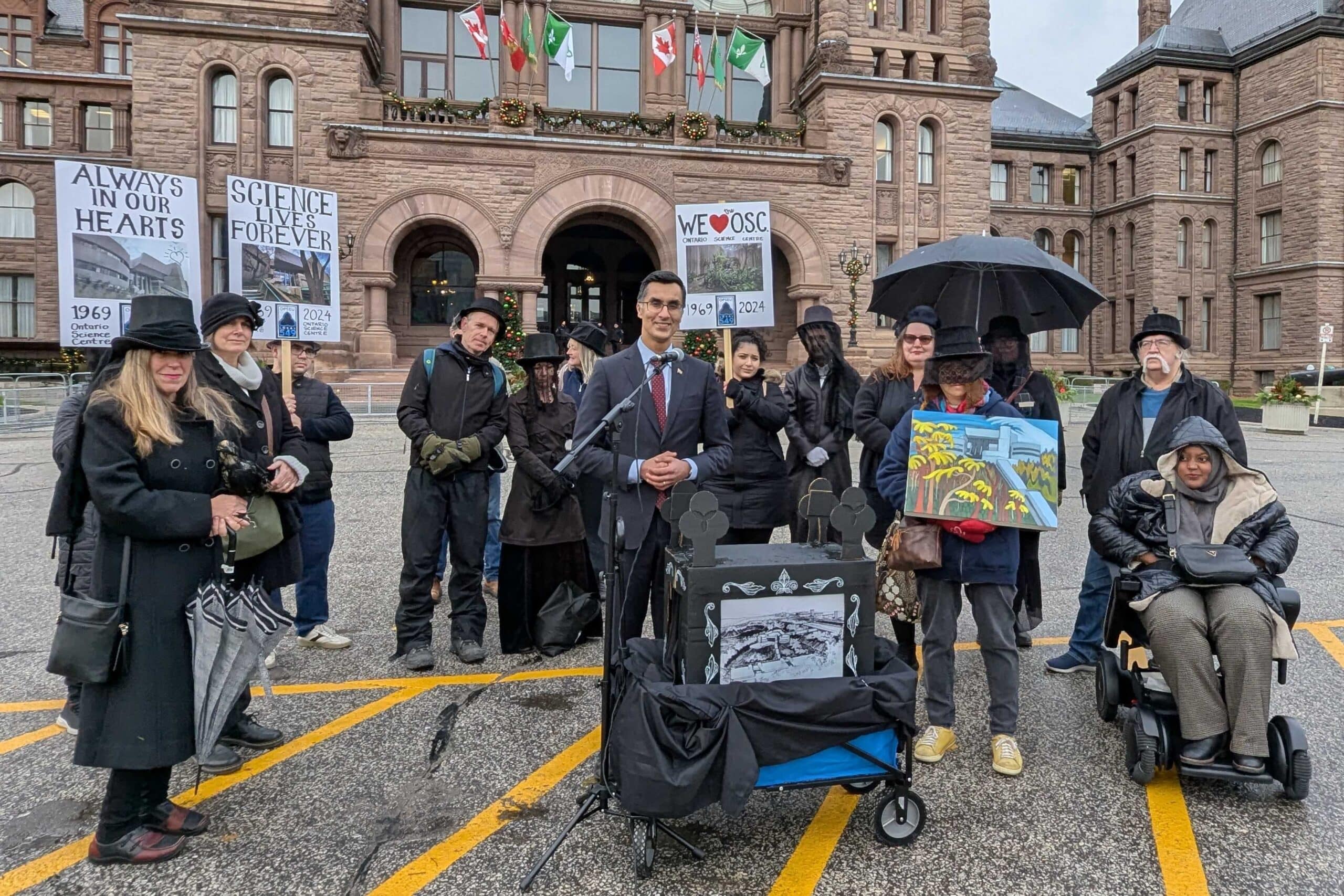
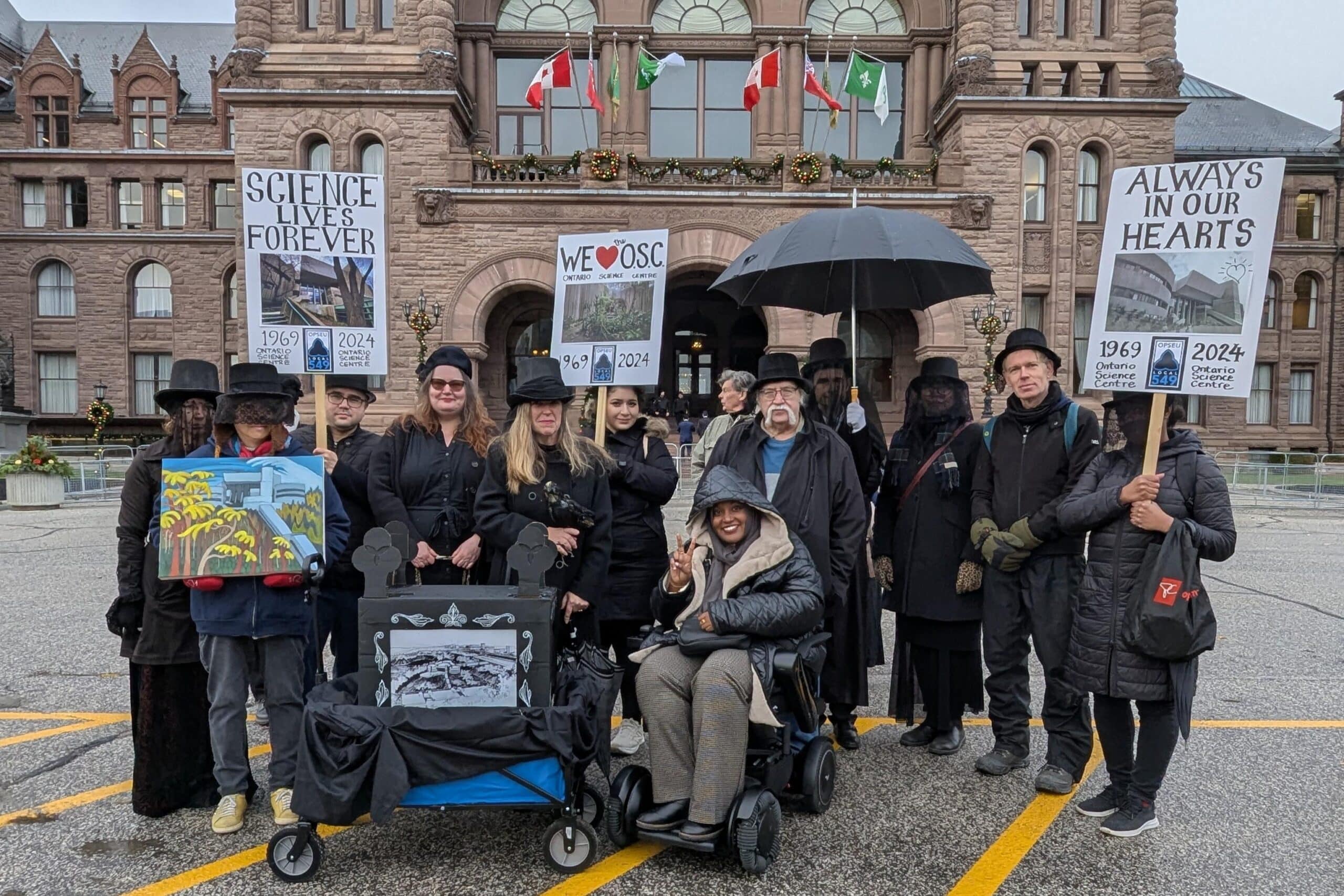
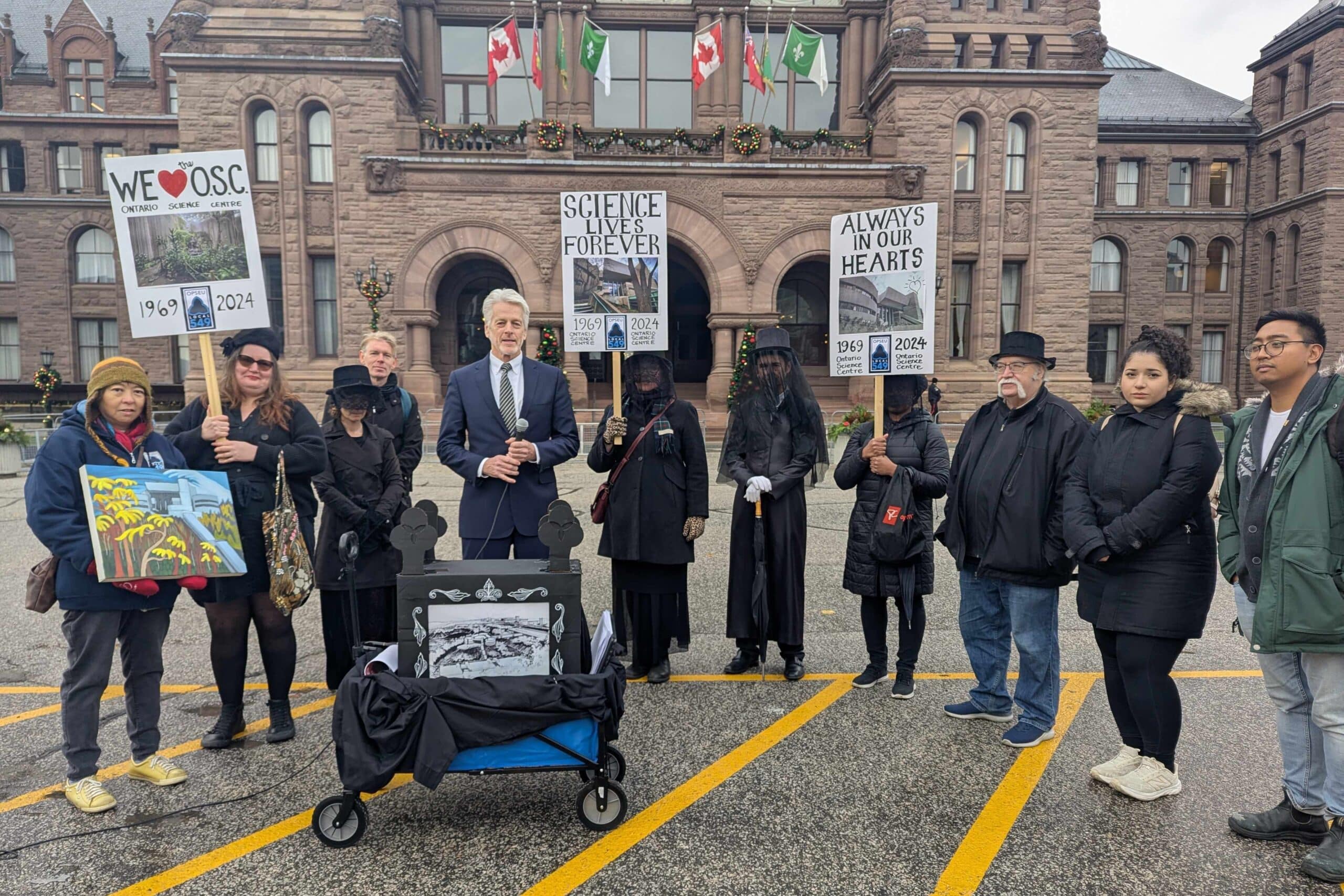
Ontario Science Centre workers – members of OPSEU/SEFPO Local 549 – held a funeral procession and memorial service at Queen’s Park yesterday, where they shared their memories and love for the Science Centre.
Five opposition MPPs attended the memorial at Queen’s Park, and together the workers and MPPs vowed to keep fighting against the Ford government’s closure of the building at 770 Don Mills Road. The workers appreciated the words of support and encouragement from MPPs Dr. Adil Shamji (Don Valley East), Dr. Jill Andrew (Toronto-St. Paul’s), Sarah Jama (Hamilton Centre), Peter Tabuns (Toronto-Danforth), and Chris Glover (Spadina-Fort York).
The funeral procession started on Bay Street in Toronto at the Ministry of Infrastructure, which operates the Ontario Science Centre. The “mourners” wore funeral black clothing and walked behind a black box emblazoned with pictures of the Ontario Science Centre, accompanied by a loudspeaker playing funeral masses and jazz funeral music.
(Photo credit: Jeff Slater)
CityNews Toronto captured scenes from the funeral procession and interviewed Martin Fischer, Local 549 President. Fischer expressed his hope that Premier Doug Ford would listen to the three quarters of Ontarians from the GTHA who want the Ontario Science Centre building reopened to the public immediately while they fix the roof, according to an Angus Reid poll commissioned by OPSEU/SEFPO.
The Science Centre workers’ mock funeral comes on the heels of an explosive investigative report by Global News about how Infrastructure Ontario was in contact with the engineering firm about its expert report and making arrangements to close the Ontario Science Centre before the report was submitted.
While the mock funeral was a theatrical protest, the feelings of grief and loss felt by Science Centre staff have been very real since the Ford government locked the doors of the Ontario Science Centre to the public in June, and then to front line staff on October 31.
Despite Doug Ford’s promise that there would be no job losses as a result of his plans for the Ontario Science Centre, all of the food services and custodial workers have been laid off. And this unnecessary closure has disrupted the mission of the Ontario Science Centre and their dedicated staff to provide educational experiences in science to kids, families, schools and the general public.
The message from Ontario Science Centre workers to Premier Doug Ford is clear: It’s not too late to do the right thing and re-open the Ontario Science Centre now!
After nearly five months at the bargaining table, one thing rings clear: any plan that carries us forward will be shaped by faculty proposals, not imposed by the CEC.
On October 28th, we tabled a comprehensive offer of settlement. While our side showed significant movement on key issues, the CEC maintained all but one of their 30+ original concessions. Allowing these concessions to hold will begin a race to the bottom, where all of us will take a hit on our paycheck, our job security, and the rights and protections we’ve won in previous rounds.
Faculty can’t afford a contract that forces us backwards, especially not now. It matters that we hold fast behind our proposals – it matters for our collective futures and the survival of our division.
We continue to prepare our mediation brief for Mediator William Kaplan, who is scheduled to conduct mediation between the parties on December 6-8. By way of a reminder: although we have secured a strong strike mandate, both sides have agreed not to escalate pending the results of mediation. A “no-board report” – which can be requested by either party, initiating a strike or lockout position – has not been requested.
On December 9th, the no-escalation agreement may be renewed by both sides or it can be left to expire, depending on whether progress is made during mediation.
The bargaining landscape is far from an even plane. Despite signing a Memorandum of Agreement (MOA) which includes the agreement between parties not to escalate, the College Employer Council (CEC) and several Colleges appear to be implementing their proposed concessions (e.g the removal of asynchronous course hours).
In addition, several Colleges are placing employment security at risk through what amounts to “constructive layoffs” – where hours of work are reduced or eliminated – of partial-load members and by making direct threats of full-time faculty lay-offs. At some colleges, College Employment Stability Committees (CESC) have been called to plan for full-time layoffs, and emails from College Presidents to employees are loudly projecting revenue decreases and reduced student enrolment to justify their course of action. All the while, to echo union leaders at St. Lawrence College, “while staff are being asked to find efficiencies, the expansion of high-salary, non-student-facing management positions stands in stark contrast.
We are exploring every tool available to respond to what amounts to a bold, egregious austerity attack on workers. The CEC and the Colleges will use this moment to try and divide us, to erode the power we build through unity, to pit workers against each other, and to fracture solidarity. It’s the oldest playbook, with an equally tested, tried, and true antidote – workers must stand together.
We will not blink: especially in the face of an employer ready to cry poor after raking in record profits year after year. Protecting the fabric of quality, public education starts with resourcing faculty on the frontlines. We are in a defining moment – and as members made abundantly clear, we are prepared to stand together.
In solidarity,
Your CAAT-A Bargaining Team:
Ravi Ramkissoonsingh, L242, Chair (he/him)
Michelle Arbour, L125, Vice-Chair (she/her)
Chad Croteau, L110 (he/him)
Bob Delaney, L237 (he/him)
Martin Lee, L415 (he/him)
Sean Lougheed, L657 (he/him)
Rebecca Ward, L732 (she/her)
Stay Informed, Stay Engaged, Get Involved
Members are encouraged to follow us on social media, where we are posting regular & timely updates:
In a significant step forward for OPSEU/SEFPO’s campaign against paid-plasma in Ontario, Toronto has officially been declared a paid-plasma-free zone.
On November 13, Toronto City Council passed the motion signifying its opposition to private, for-profit blood collection in the city. The motion was brought forward by Councilor Chris Moise and seconded by Councilor Alejandra Bravo.
“The practice of collecting blood in exchange for payment is immoral and exploits Ontario’s vulnerable communities. It endangers Ontario’s blood supply and puts patients at risk, said Geoff Cain, Chair of OPSEU/SEFPO’s Blood Services & Diagnostics sector. “I applaud Toronto City Council for safeguarding the integrity of our public, voluntary blood donation system.”
OPSEU/SEFPO members working for Canadian Blood Services (CBS) have been fighting against the expansion of paid plasma in Ontario after an agreement was signed between CBS and private pharmaceutical corporation, Grifols, to open five paid plasma centres in the province: Etobicoke, North York, Hamilton, Cambridge and Whitby.
Both Hamilton and Toronto City Councils have now declared their opposition to paid plasma in their cities; however, the responsibility for blood regulation ultimately lies with the provincial and federal governments.
“This is a significant step forward to ban paid plasma from our province,” said OPSEU/SEFPO President JP Hornick. “Ontario’s cities are speaking out to protect their residents, yet the Ford government continues to choose profits over people. We cannot let Canadian Blood Services, and the Ford government, exploit donors and put the safety of our blood supply – and our lives – in jeopardy.”
Canada’s tainted blood scandal, which occurred in the 1980s, took the lives of 8,000 Ontarians. Following this, the 1997 Krever Inquiry report looking into this preventable tragedy made the following recommendations: Canada’s blood system should be a public resource; donors should not be paid for blood; and access to blood products should be universal and free.
To support CBS workers in the fight against paid plasma in Ontario, visit opseu.org/nopaidplasma
The OPS Unified Divisional Conference this past weekend was a remarkable experience for all involved.
“I want to extend a heartfelt thank you to the incredible delegates, alternates, and attendees who turned this gathering into a celebration of possibility, courage, and unity. Your energy and determination illuminated the space, proving the strength we possess when we are Unified for a common cause” said newly re-elected CERC Chair Amanda Usher.
At the conference, elections were held for the MERCs and CERC.
Usher emphasized the power of collective voices, adding “this conference was a testament to what we can achieve together. Whether you were a candidate, supporter, or participant, your presence was vital. You all demonstrated the courage to engage and take proactive steps toward meaningful change.”
As the conference coincided with Taylor Swift’s visit to Toronto as part of her Eras Tour, OPS Unified members had the opportunity to make solidarity friendship bracelets and celebrated the theme of their “Unified Era”.
“This is our moment – our Era – an opportunity to connect, inspire, and forge a clear path forward for our OPS Unified Division. Together, we are embracing a #UnifiedEra, where our collective strength is undeniable,” said Usher.
OPS Unified is more than 30,000 members strong, with members working in every corner of the province. Together, OPS Unified members will continue to tackle the challenges of our times: from opposing privatization and layoffs to advocating for a better contract, equity, and stronger public services for all Ontarians.
Throughout the conference, members listened to presentations on member organizing, leader identification and workplace mapping and participated in practical exercises to start this important work.
With the MERC teams, a Unified CERC, a strong bargaining team, mobilizers and an engaged membership we will organize, mobilize, and hold our employer accountable and demand the changes we need to win.
Usher also extended her appreciation to the outgoing MERC Chairs and the dedicated MERC & CERC team members: “your relentless commitment and advocacy have laid a strong foundation for our future endeavours, and we are grateful for all of your hard work.”
OPS Unified election results:
Central Employee Relations Committee (CERC)
Chair: Amanda Usher
Vice Chair: Chris Eckert
Member: Leslie Aiston
Ministry Employee Relations Committees (MERCs)
Agriculture, Food and Agribusiness
Chair: Marcus Rangai
Vice Chair: Fadi Al-Daoud
Member: Binod Baral
Member: Sanjay Sharma
Member: Pervin Pereira
Attorney General
Chair: Loretta Clark
Vice Chair: Deborah Tozzo
Member: Ashlee Elliott
Member: Margaret Hotchkiss
Children, Community and Social Services (Unified)
Chair: Susan Fournier-Roy
Vice Chair: Brandon Yohnicki
Member (FRO): Brenda Henry
Member (CPRI): Steve Kelly
Member (ODSP): Robert Hampsey
Member (ODSP): Christopher Cassel
Member (H&S): Michael Greene
Colleges and Universities
Chair: Chantal Cooper
Education
Chair: Daryl O’Grady
Vice Chair: Drew Finucane
Member: J. Robert Scarfo
Member: Rhonda Gauthier
Environment, Conservation and Parks
Chair: Shawn Burr
Vice Chair: Alexander Miller
Member: Christopher McConnell
Member: Larissa Hutton
Finance
Chair: Shanika Duncan
Vice Chair: Juliette Losson
Member: Patrick Davidson
Health
Chair: Amanda Usher
Vice Chair: Holly Sullivan
Member: Grace Grieve
Member: Gord Garrity
Labour, Immigration, Training and Skills Development
Chair: Leslie Aiston
Vice Chair: Shaun Carter
Member: Karen Kristel Jacobe
Member: Melinda Mullally
Long-Term Care
Chair: Janet Groux
Vice Chair: Sylvie Byrnes
Member: Kehinde Sangill
Mines
Chair: Gregory Paju
Vice Chair: Colleen Kurcinka
Member: Mateo Dorado-Troughton
Municipal Affairs and Housing
Chair: Leanne Esarik
Natural Resources and Forestry
Chair: Jeremy Rouse
Vice Chair: Jessica O’Donnell
Member: Jeremy Verdiel
Member: Michelle Riley
Northern Development
Chair: Marla Michel
Vice Chair: Siobhan O’Leary
Member: Ryan Lipcsei
Member: Mary Lynn Riberdy
Ontario Clean Water Agency
Chair: Chris Eckert
Vice Chair: John Bristow
Member: Darren Aljoe
Public and Business Service Delivery and Procurement
Title: Secretary – Education (40) Location: Campaigns, Policy Research & Education Unit, Political Action and Education Division, OPSEU/SEFPO Head Office, 100 Lesmill Rd, Toronto, ON M3B 3P8 Reporting to: Supervisor, Campaigns, Policy Research & Education Unit Search Type: Open to all OPSEU/SEFPO members Salary: $1,520.00 to $1,587.00 per week (Range 5 – Support) Working Conditions: As provided in the OPSSU/OPSEU/SEFPO Collective Agreement
Principal Duties:
Provides secretarial and clerical support services to the Unit:
Responds to general enquiries
Takes minutes or recordings of meetings in the absence of an administrative assistant
Receives and takes messages and refers to proper individual
May organize large mail out of resource materials as requested
Books appointments and meetings for the Unit and coordinates special conferences as required
Produces agenda and minutes for Unit meetings
Maintains and updates records for filing systems and/or databases
Compiles summary reports from information as requested
Prepares documents, reports, briefs, composes letters and acknowledgements
Proofreads and corrects prepared materials for correct grammar, format, completeness and content
May make arrangements for meetings and may assist in organizing conferences including registration
Assists in organizing materials for distribution
Maintains and updates procedures manuals of own position
May train others in their area of responsibility
Perform other related duties as assigned
Qualifications:
2 year Community College Certificate and two years of related work experience (or an equivalent combination of experience and education)
Knowledge of office management principles
Knowledge of OPSEU/SEFPO organization, structure and policies
Understanding of and commitment to labour movement and social democratic philosophy
Understanding of and commitment to the principles of anti-racism, equity, diversity and inclusion
Requires intermediate PC skills and knowledge of relevant software packages
Requires tact and diplomacy skills
OPSEU/SEFPO supports employment equity. Racialized workers, women, Indigenous workers, LGBTQ2S+ workers and workers with disabilities are encouraged to apply. For the purpose of statistical data collection, applicants are strongly encouraged to voluntarily self-identify. OPSEU/SEFPO’s diverse workplace also supports Francophone workers and young workers.
A total of 60% or greater must be achieved in the competition process to obtain the position.
Please advise should you require any accommodation to participate in this competition.
Expression of Interest – 2-step process:
Submit your resume with cover letter in Word or PDF to competitions@opseu.org quoting “24.047 – Secretary – Education (40), Campaigns, Policy Research & Education Unit” by 5:00 pm (Eastern Time) on December 5, 2024;
To be considered in the job competition, it’s essential to complete both steps of the two-step submission process. Failure to do so may result in disqualification from consideration.
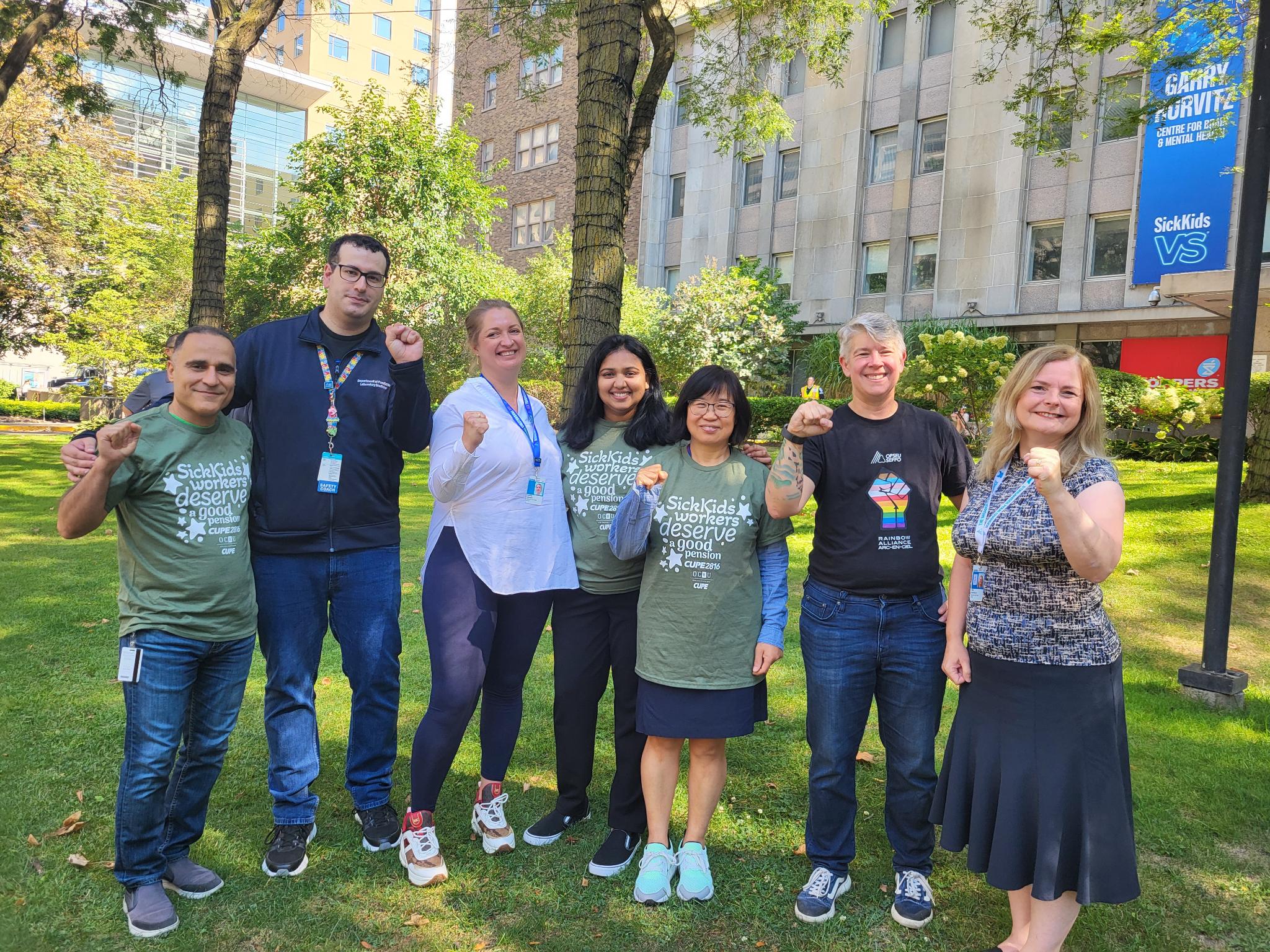
On December 3, we’re calling on SickKids to join the Healthcare of Ontario Pension Plan (HOOPP) so workers can retire with dignity and financial security!
CUPE Local 2816 and OPSEU/SEFPO Local 5114 and the Ontario Nurses’ Association will be holding a joint rally in solidarity with workers at SickKids hospital.
SickKids has not contributed to the hospital’s pension plan since 1997. Instead of using the pension plan’s surplus to improve workers’ benefits, SickKids has chosen to extend its pension holiday for the 26th year in a row.
After years of supporting sick children, healthcare workers at SickKids deserve pension plans that will support them in their retirement; not put them in a position of financial insecurity.
Rally in solidarity with SickKids workers! Click here to RSVP.
Pension Board (retired before Dec. 31,1992), 1-800-668-6203
OPSEU Pension Trust (retired after Dec. 31,1992), 1-800 906-7738
CAAT Pension Plan, 1-866-350-2228
HOOPP Pension Plan, 1-888-333-3659
OMERS Pension Plan, 1-800-387-0813
Province of Ontario – OPSEU – Travel Insurance -Can/USA, 1-855-222-4051
OPSEU Head Office, 1-800-268-7376
A Message from the Retired Members Division Chair
Don’t Let Doug Ford Buy Your Vote With Your Money As The System Fails Us!
We are anticipating an early election. So, what does Doug Ford do? He will be sending two hundred dollars ($200) to every taxpayer, as well as $200 for each eligible child in early 2025. That’s 15 million people totaling 3 billion dollars. Even the richest of the rich will get a cheque, the same as those on ODSP and Ontario Works who are not getting enough money for food and shelter now.
Where is the investment in ambulance care, in family medicine, in long term care, in home care, or affordable housing? All these investments would make a difference in the lives of seniors. Doug Ford has demanded, and I repeat demanded more money from the federal government because the health care system in Ontario needs more money…. then he turns around and gives it to every man, woman and child. That won’t help us when we need medical care.
The Toronto Star reported that on October 18th, 2024, Euplio Cusano was beaten to death at the Toronto South Detention Centre. Euplio was 69 years old and had been living in a long-term care facility due to a brain injury and epilepsy when he was involved in an altercation with another client. The police he was arrested and charged with assault. He ended up being incarcerated at Toronto South Detention Centre for more than 7 months without a bail hearing. All our public services and safeguard systems failed him.
The long-term care system failed him as they refused to take him back to the facility. The system did not prioritize him in a new facility that had staffing or the level of care to meet his needs. Profit is more important than people in this mostly for-profit system.
The Public Trustee and official guardian system failed him, he was in their care. It should have been their responsibility to get him placed quickly in a new facility.
The Court System failed him, by allowing him to remain incarcerated for 7 months without bail and allowing repeated remands.
The Legal Aid System failed him. He never should have been in the system.
The Correction System failed; he was tripled bunked in the over crowed jail. In a system that was not able to meet his needs.
The Mental Health System failed him. In the past we had units for seniors with mental health issues that may have violent tendencies. We also provided trained nurses and doctors, not PSW’s, that are severely over-worked and not trained to meet this level of care.
Seven months in prison basically because the system had no place for him. He never should have been criminalized in the first place for being old and having a brain injury. Seven months in prison basically because the system had no place for him is not acceptable. Our government failed him! All safety nets in place failed him! He could have been your spouse, your sibling, your parent or you!
The people working in long-term care, the Office of the Public Trustee and Guardian, Legal Aid, the Court System or the Correction system are not bad people. They are working in systems that have been underfunded and understaffed for decades, causing many of them burnout and other mental health issues and physical ailments related to stress. They are doing their best.
Doug Ford will defend his government as he always does by saying they are spending more money and hiring more people in every aspect of government service than has been done in the history of Ontario. Don’t believe the propaganda that “we are spending more money than ever before”. We should be spending more! The population of Ontario is growing and so has inflation. You can’t compare previous spending to today’s spending when there has been such a large increase in the inflation rate and population in Ontario. Doug Ford often argues with regarding the federal Government (inflation) and housing (population growth) numbers over the years without relating them all into today’s dollars.
Seniors need long term investment in these systems, not $200 each.
Doug Ford, use those 3 billion dollars to provide quality not for profit services for the province.
In Solidarity, Sandra Snider –OPSEU/SEFPO Retired Members Division
Beware! Service Canada will never request the following information by email or text:
your SIN
your credit card #
your bank account #
your passport #
Still unsure? Call 1 800 O-Canada to find out whether the communication you received is legitimate.
Cruising
by Ed Faulknor, Chair of Region 2 RMD
Back in 1993, Kathy, my lovely wife, and I embarked on our very first cruise. It was on a ship called “The Song of America” with Royal Caribbean Cruise Line and because it was our very first cruise, we thought the ship was enormous. By today’s standards, it was barely more than a tugboat, but it was a great experience and lots of fun. We ran about the ship doing various activities and earning shipshape dollars and ten of those got you a ship shape T-shirt. I tell you this just to let you know that on a cruise ship there is no end to all the possible things you can do to keep entertained, from exercising to group games to just lounging by the pool and reading your book. With this cruise began our love affair with the adventures of cruising.
Since then, we have been privileged to go on twenty-five cruises so far and our next one is already booked for November of this year. We have covered most islands in the Caribbean, been to Tahiti and the Society Islands, went through the Panama Canal, went to Hawaii and circumvented the islands there, flew to Sydney Australia and did a two-week cruise of the Fiji Islands and on our most recent trip we did a trans-Atlantic from Florida to Bermuda to Gibraltar and Spain.
These many trips and experiences have educated both my wife and I on what to look for to make a cruise successful and what, if possible, you should avoid. Keeping in mind we all have different tastes and preferences, but the following is what we have found works for us.
Research whatever cruises you are considering on the cruise line web pages to check itinerary, information of the ship, departure and return dates, and what shore excursions are available.
Book your dining preferences early to get the time of day and size of table you want. Be sure to notify the ship of your dietary concerns and allergies when doing this.
Pre book your shore excursions on the same basis. The good trips go fast and if you wait till the last minute, you may miss out on a trip you really want.
Smaller ships make for more intimate gatherings and closer relationships. They also can get into a lot of ports the bigger ships can’t, which affords greater experiences. The Paul Gaughan from Papeete Tahiti, to Bora Bora, Morea, and the other society islands is a perfect example of the smaller ships and why we prefer them.
Just because you have been to a port of call before, doesn’t spoil the location. Different shore excursions give you a whole new perspective on the island or city that you didn’t get the first time around.
Many new travelers get worried about sea sickness. Don’t! Today’s ships are so big and stable that you forget you are on one, half of the time.
Sign up for each cruise line’s loyalty program when you sail. It doesn’t take too long to start getting freebies & perks which can save money.
If you are a light drinker of alcohol, stay away from the drink packages, unless it is thrown in as a perk. The number of drinks per day to justify the cost of a package is well beyond my level of normal consumption and Kath doesn’t drink at all. If 1 person in your cabin takes the drink package, then both of you have to take it.
Positioning cruises where they are taking a ship across the ocean for an extensive stay will require you to fly home but are surprisingly cheaper than your standard 10-day Caribbean Junket and is a nice change of pace.
Watch for lectures and movies and evening theatre presentations, which are all part of the fun and entertainment.
Walk when you can to burn off all those extra calories from the great meals, but if you can’t just enjoy every minute of it. Anyway, cruising is a great way to break up those long cold winters.
Kath and I have a cruising mantra that simply is – as long as our health and money holds out, we will keep on cruising and enjoying ourselves and so far we see no reason to stop.
Dispelling Travel Insurance Myths
Whether you are travelling by yourself or with your family, for a single trip or multiple trips, it’s nice to know you’re covered in the event of many emergency illnesses or injuries, and in case any other travel-related mishaps occur. Travel Insurance plans are designed to help protect you and your family – wherever your travels take you!
Emergency medical coverage is critical
Nobody wants to think about getting sick or injured on vacation, but it happens. And when it does, having insurance gives you one less thing to worry about. Let Travel Insurance take the load off coordinating care and covering potentially huge costs. Our plans may also cover pre-existing conditions.
Whether you’re heading south, travelling in Canada or going to Europe, travel insurance is wise. Don’t fall prey to these myths!
Myth 1. You’re covered under your Government Health Plan.
Your Government Health Plan may not cover all your emergency medical expenses—even if you’re travelling in Canada. For instance, it won’t cover ambulances, prescription drugs and dental. A single ambulance ride will likely cost more than the average travel insurance plan.
Myth 2. Multi-trip plans are expensive.
Multi-trip plans use one policy to cover numerous vacations taken within 365 days of the date of purchase. If you’ll be taking a few trips anywhere from four to 60 days in one year, this plan will save you money since it covers several trips with a single policy. CAA Travel Insurance offers both a Multi-Trip Medical Plan and a Multi-Trip Vacation Package Plan. Plan to cover all your bases.
Myth 3. Airlines will reimburse you for expenses.
If your flight is delayed until the next day, airlines rarely cover the cost of your unused hotel room. Vac package insurance plans often include trip cancellation and interruption coverage, so your lost hotel room will be covered. Cancellation and interruption plans also typically cover lost luggage, so you’ll have an allowance to buy some clothes while the airline finds your bags.
Myth 4. Short trips don’t require insurance.
Don’t convince yourself that it’s all right to travel unprotected for just a few days or just a short trip across the border. Travel insurance will give you peace of mind that you’re
protected.
talk to friends, family, and neighbo
Myth 5. Your credit card coverage is sufficient.
Many credit cards only cover trip interruption and baggage loss or have limits on how much travel insurance they provide. They also may not cover people over 65. Review your credit card plan carefully and consider an additional policy to fill in any gaps.
Myth 6. I can just pay out-of-pocket if something happens on vacation.
In places like the U.S. and Mexico, medical costs and hospitals can be extremely expensive. Many medical providers require upfront cash payment before they will treat you. Trip cancellation and insurance typically costs 4%-10% of your total, prepaid nonrefundable trip cost. That’s a small amount compared to the total cost of your trip!
So before you travel this winter, ensure you purchase travel coverage before you go – your life may depend on it!
This article was written for Autumn View by Leony deGraaf Hastings of a certified financial planner from deGraaf
We offer renewal reminders as a fast & simple way to get notified when it’s time to renew your:
Self-Evaluation Of Health: How Do Our Seniors Rate?
Canadians are living longer and benefit from a higher standard of living through advances in medicine, technology, nutrition, and health care. Improved housing and living conditions have also made a significant contribution. Improving the health status of seniors is an important goal of Canada’s health care system.
What do we mean by “health?” A popular definition of health, especially as it pertains to seniors, was developed by the World Health Organization (WHO). The WHO defines health as “a state of complete physical, mental and social well-being and not merely the absence of disease or infirmity.”
Can the health status of seniors be determined through self-rating methods? Initially, self-ratings of health were developed to determine how health affects the general functioning of seniors; specifically, how health affects seniors’ physical capacity for role fulfillment and social participation. Self-rating or self-evaluation of one’s health is a complex issue. The health care field is fraught with medical, social, and attitudinal complications which can bias the subjective response of seniors. If self-evaluation measures are viable, this method of health assessment can supplement our current body of knowledge and help serve the needs of our increasing population of seniors. The implementation of programs for the prevention and detection of health problems and distribution of health care services, require a thorough knowledge of the health status of seniors. Health status information is also beneficial in understanding the prevailing attitudes toward health and health care by seniors, in research, and in formulating policy.
Various methods such as interviews, rating scales, surveys, and checklists can be used to obtain a subjective evaluation of health. One method is to ask seniors to rate their health as excellent, good, fair, or poor (rating scale); another is to ask them to compare their present state of health with others their age (comparison rating); and still another is to inquire about illnesses, diseases, and injuries that affect them by using a checklist rating system.
How valid is the self-evaluation rating of health by seniors as it relates to the physician’s health rating? In a study to determine the validity of this relationship, seniors were asked to rate their health as either excellent, good, fair, or poor. The senior’s medical history was obtained by a physician preceding the medical examination. The results of the study indicated that self-evaluation of health was significantly correlated with the physician’s health rating. A survey of the published research found a positive relationship between seniors’ self-evaluation of health and physicians’ health rating, with a level of agreement as high as 75%.
Caution, however, must be exercised in the interpretation of health and disability data based on self-reports by seniors. The issues of concern include (a) the extent to which self-reported health reflect true health status, and (b) the extent to which seniors reflect social processes (i.e., perceived demands by the interviewer, such as whether the information provided by seniors would be used to deny benefits).
What is the relationship between seniors’ self-evaluation of health and other factors of social life, such as the way males and females assess their health status? Within similar categories of self-rated health, one study found (a) that women tended to tolerate more health problems than men, and (b) that males expressed poorer health than females.
One researcher found that self-evaluation of health among the 65–74-year-old group and the 75+ group was significantly related to measures of objective health status. Findings indicated that although the 75+ group reported more health-related problems (as would be expected), they were more positive in their self-evaluation of health than the 65–75-year-old group. As well, the 75+ group who evaluated their health to be excellent, manifested about the same degree of disability as seniors in the 65-74 age group, who considered their health to be good.
Does self-evaluation of health differ significantly between institutionalized and noninstitutionalized seniors? While it is true that many older seniors suffer from chronic health conditions like heart disease, arthritis, and diabetes, most institutionalized and noninstitutionalized seniors say they are in good or excellent health. In a study conducted by this author at the City of Thunder Bay Homes for the Aged, 48% of institutionalized seniors described their health as good or excellent. In comparison studies with noninstitutionalized seniors in the United States, 49-59% of seniors reported to be in this category.
The impact of socioeconomic factors (e.g., income, occupation, education, social status) on seniors’ self-perception of health is complex. Results suggest that research should focus attention on the social consequences of ill health (i.e., retirement, unemployment) rather than presumed sociological causes.
Overall, the research literature supports a positive relationship between seniors’ self-evaluation of health and physicians’ health rating. As a result, self-evaluation measures of health appear to be related to measures of objective health status and can be of value when objective measures of health are not feasible. Self-evaluation methods can provide a valid, cost-effective means of health assessment in experimental or survey research involving seniors where other forms of health information are lacking.
It is important to understand that a senior’s self-evaluation of health is not intended as a substitute for a medical examination by a physician. Self-evaluation is valid only in the context of the senior’s personal perception of health.
Seniors Mobilize across Canada on October 1st
By Barbara Linds, OPSEU/OPSSU Retiree
My grandson Escher will turn 9 on Christmas Day. I became involved in seniors’ climate action soon after he was born because I’m concerned about the world we are leaving for our grandchildren.
I am a member of Seniors for Climate Action Now! and an organizer with Seniors for Climate.
Seniors for Climate was formed this past spring at a discussion by 6 seniors climate organizations across the country – Seniors for Climate Action Now, Grandmothers Acting to Save the Planet, the Suzuki Foundation, Climate Action for Lifelong Learners, Climate Legacy, and For Our Children.
These groups decided that October 1st, National Seniors Day in Canada, and also, since 1990, the United Nations Day for Older Persons, should be a day to focus on the climate crisis and to mobilize seniors to take action.
Following this, 61 organizations across the country endorsed the project, including the OPSEU Retired Members Division. Thanks so much for your support!
I had the great privilege of using the organizing skills I developed in my 30 years working for OPSEU to support groups across the country as they planned their actions.
At the end of May we had confirmed climate action events in 18 communities. By October 1 this had grown to 76, 34 of these in Ontario.
Across the country groups organized everything from large rallies and festivals to potluck dinners and coffee parties in seniors’ residences. There were workshops and demonstrations. Climate expos and meetings with politicians. Flash mobs and Raging Grannies. They got petitions going, including one to the House of Commons. There were newspaper ads, letter writing campaigns, art installations and music. There were seniors in rocking chairs outside RBC branches calling attention to Canada’s biggest fossil fuel lender.
A number of municipalities across the country proclaimed October 1 as Seniors For Climate Day, including Toronto, Kingston and Grimsby in Ontario. These proclamations were very clear in their focus. The Kingston proclamation read, in part “Whereas we must reduce carbon emissions for a livable future. Extreme weather is the symptom; fossil fuel pollution is the cause…”
One of the ways we united seniors across the country was with a personal pledge that was read and signed at each event. It reads in part:
In pledging support to future generations, I recognize the debt we owe to Indigenous wisdom: the decisions we make today must assure a better future for the seven generations that will come after us.
I will bring my skills, compassion and resources to join with others in a movement for environmental justice.
I pledge to use my voice and my vote to protect future generations. Later Is Too Late!
What’s next?
Organizers from across the country met recently to share their experiences from October 1. All agreed that we must continue to mobilize, as seniors, and with others to save our planet. Seniors for Climate events will happen in 2025. Stay tuned!
Please get involved!
I encourage you to go to seniorsforclimate.org for more information. Please sign the online pledge and sign up to receive regular updates.
Barb Linds speaks at at a climate action event in Nappanee
Seniors for Climate Action Now! (SCAN!)
Confronting the Climate Crisis and Working for a Sustainable, Caring, and Equitable Society
The climate crisis is here. We seniors are alarmed.
Wildfires, heatwaves, and floods are endangering our lives and society
High levels of pollution are affecting our health
Climate breakdown is destroying our natural world.
The climate crisis is THE crisis of our time. We need radical action.
The main culprits are the oil, gas and coal industries
Fossil fuels must be phased out as soon as possible
The oil and gas industry should no longer be subsidized by public money
Banks and our Canada Pension Plan must divest from fossil fuels.
We must set new priorities.
Make huge investments in renewable energy, especially wind and solar
Make public transit free to get more private vehicles off the road
Create a public national railway system
Provide more affordable housing with subsidies for sustainable retrofits
Increase industry regulation to promote production of goods that last and save energy
Increase electrification
Ensure the preservation and enhancement of our natural ecosystems.
We also need special measures to cope NOW.
Cooling centres and free air conditioning in all rental units
Flood protection and increased firefighting capacities
Early warning and service systems for weather disasters
Indigenous knowledge and rights are central to a sustainable society.
SCAN! supports Indigenous sovereignty and the Land Back movement
Indigenous stewardship of land and water provides a model for our relationship to the natural world.
We must create a caring and equitable society by
Supporting workers in their transition from carbon intensive industries to sustainable jobs by providing free training and income support increasing low carbon public service jobs in education, health care, and other social services
Taxing the top 20% of Canada’s wealthy, the most responsible for the climate crisis
Redistributing wealth and reducing inequality.
Canada has international responsibilities.
We are one of the worst per person climate polluters in the world
We need to provide “no strings attached” funds to countries of the Global South to help them transition to a sustainable economy
We must support the growing number of climate refugees
Canada must reduce military expenditures and promote peace.
Seniors, join the climate justice movement. Get involved.
On Thursday, November 21, we invite you to join members of OPSEU/SEFPO Local 549 for a funeral procession and memorial service at Queen’s Park to mourn the untimely and unnecessary closing of the Ontario Science Centre at its location on Don Mills Road by the Ford government.
The fight for the Ontario Science Centre isn’t over! While we mourn the months of learning that kids, families and schools have lost since the abrupt closure in June, we continue to demand that the Ford government re-open the Science Centre immediately. It’s not too late to do the right thing!
Join us on Thursday, November 21, 1:30-3:30 p.m.!
1:30 p.m. – Gather in front of the Ministry of Infrastructure offices at 777 Bay St., Toronto
1:45 p.m. – Funeral procession walk to Queen’s Park (1 Queen’s Park Cres. E., Toronto)
2:30 p.m. – Memorial service in front of the Ontario Legislature building
Funeral attire is welcome but not required. Please share this invitation with others who would like to attend!
Together, we will walk in a funeral procession to Queen’s Park with photos and posters to honour the vibrant life of the Ontario Science Centre. We will then hold a memorial gathering in front of the Legislature, where guests will have the opportunity to speak about what the loss of this beloved institution has meant to each one of us.
Whether you have fond memories of your own visits to the Ontario Science Centre, or you value the maintenance of a public institution created to enrich its citizens, we invite you to join us to recognize this cherished treasure and to demand that the Ford government reverse this disastrous decision immediately.
What the Ontario Science Centre means to all of us
The Ontario Science Centre is more than a tourist attraction, field trip destination or building. Established as a gift to the people of Ontario in celebration of Canada’s centennial, it was one of the first two interactive Science Centres – paving the way for over 3,000 similar institutions worldwide.
For Science Centre workers, it is a place to reimagine science and technology in ways that have been engaging, inventive, and meaningful to our visitors. The Centre’s reach extends to the hundreds of locations around the world where our made-in-Ontario exhibits have travelled.
To observe International Solidarity Day with the Palestine People taking place on Nov. 29, 2024, OPSEU/SEFPO’s Coalition of Racialized Workers (CoRW) and Provincial Young Workers Committee (PYC) will be hosting a free Zoom Room Educational Webinar on Saturday, Nov. 30, 2024, from 1pm to 3pm, and Monday, Dec. 9 , 2024, from 7pm to 9pm.
In partnership with Labour for Palestine, it will be a presentation and conversation about the Labour Against Apartheid Campaign, discussing the history of Palestine and meaningful actions to show solidarity.
The Educational Zoom Room is open to all OPSEU/SEFPO members.
Register here for the November 30 Webinar from 1:00 PM to 3:00 PM
Register here for the December 9 Webinar from 7:00 PM to 9:00 PM
If you have any questions for the CoRW or PYC , please submit them to equity@opseu.org in advance of the event.
In Solidarity,
OPSEU/SEFPO’s Coalition of Racialized Workers and OPSEU/SEFPO’s Provincial Young Workers Committee (PYC)