
dev-os

dev enviro for os

  • Grievance Arbitrations: Frequently Asked Questions

    Grievance Arbitrations: Frequently Asked Questions

    So your Grievance is finally headed to Arbitration, but you have questions.

    How do you prepare, what is involved, and what is an arbitration, anyway?

    What should I wear at the arbitration?

    Arbitration days, both in person and virtual, are business casual. While your representative will likely be wearing a suit or a variation of a suit, you are not required to.  Please be aware however, that even for a virtual arbitration you have to be fully dressed (top and bottom) and upright, unless we are in a recess or you have an accommodation that prevents you from sitting or standing upright. Please also keep in mind that on your hearing days, and indeed during your meetings, you should not do anything that you would not normally do in an in person meeting. This includes brushing your teeth, going to the bathroom, drinking alcohol, or changing your clothes. We all know the dangers of mistakenly believing that our camera is off – the safest route to wait for an appropriate opening and simply excuse yourself, the same way you would do if you were in person.

    What is the difference between mediation and arbitration?

    Mediation

    When the parties “mediate” they are attempting, usually with the assistance of a third party like an Arbitrator, to agree to the resolution of a dispute. This is usually in the form of a “Minutes of Settlement.”  A mediated agreement is usually private and is generally not published. While an Arbitrator may assist the parties, the Arbitrator has no ability to force either of them to agree to a settlement; by nature it is something the parties are agreeing to.  A settlement is final and binding when the two parties have a “meeting of the minds” – that is, when the parties agree to all the substantive terms, the agreement is binding, whether or not they have signed anything. While a verbal agreement is legally binding, we usually reduce it to writing so that we have a clear record of what was agreed to, and it is easier to enforce.

    Arbitration

    When the parties “arbitrate” it means that they cannot agree to a resolution and require a neutral third party like an Arbitrator to make a final, binding, decision about whether the Collective Agreement has been breached. You will hear us use this term interchangeably with the word “litigate”. The Union and Employer are litigating the grievance in front of an Arbitrator in a hearing. While in mediation the parties may be able to agree to a wide ambit of things, in an arbitration the Arbitrator may generally only decide if there has been a breach of the Collective Agreement.  An arbitration is less formal than a court proceeding, but does involve the calling evidence and the submission of legal arguments.

    Why Do We Mediate?

    There are many reasons that the parties agree to settle a grievance rather than litigate or “arbitrate” it, and many factors that go into what we settle for (or the “quantum of settlement”). The main one is the legal strength of the grievance: an assessment of whether we would win the grievance if we went to a hearing, and if we did, what remedy might the Arbitrator order.  Other considerations include: the losses that we can prove, the inconvenience, length and stress of a hearing, and (for the employer) the cost of a hearing, and (for both parties) the concern about having a public decision, and any number of other issues that are unique to each case. Wanting to settle is not an admission that a case is bad, or a concession that the other party’s case is good. Settlements are often a different and better result than we could achieve by arbitration, and sometimes better meet the needs of the worker.

    Isn’t the first day always a mediation?

    Not always.  Often grievances at OPSEU/SEFPO are resolved through mediation, many times on or before the first day of hearing. But how the parties spend the first day is a matter of agreement between the union and employer.  Unless both parties have agreed to mediate on the first day, there is no guarantee that is what will happen.

    When would we not agree to mediate? Well, if the Employer refuses to mediate, that would be one good example of when we could not get to that agreement.  The other times would be if we are convinced that there is no value to using a full day for mediation – if we believe that the parties are fundamentally unlikely to get to an agreement.

    Will my Local President/Chief Steward/Steward be at the Arbitration?

    Your local president, or steward is certainly welcome to attend, and we always look forward to working with them, and they are often an insightful presence.  However, OPSEU/SEFPO only covers additional costs for them to attend if they are necessary to the proceeding.  We can’t make an advance determination of every time someone is “necessary”, but  someone is often “necessary” when they are the Grievor, when they are a witness, or when they have to make a decision on a settlement that will affect their local in a substantial way.

    What’s a Grievance Officer and why are they calling me?

    Cases at OSPEU are litigated by “Grievance Officers” or “GOs” who are employed by OPSEU/SEFPO in the Arbitrations Unit.  A Grievance Officer may have a legal background, or have a background in labour advocacy through their other work; however they are all professional litigators who are prepared and ready to work tirelessly on your case.

    Even where a Grievance Officer has been trained as a lawyer they are not your lawyer – all Grievance Officers are working at OPSEU/SEFPO as employees, and none are retained as your personal lawyer.

    it is the role of a Grievance Officer to guide you through the grievance process and ultimately represent the Union at arbitration.

    My case is really important.  Am I entitled to a lawyer?

    Your case is very important, to us as well as to you. On some occasions, when Grievance Officers have scheduling or other conflicts, a case is sent to one of several outside lawyers that OPSEU/SEFPO contracts with. This is based mainly on the availability of Grievance Officers for that particular date and is not connected to how important we think your case is. You are always going to get representation,  and the representative is more likely to be a Grievance Officer than an outside lawyer.

    What if I don’t like my representative?

    It’s never fun to have to work with someone you don’t like, and it is extra difficult when the work you are doing is on your grievance. But, just like a work place, sometimes we deal professionally with people we wouldn’t choose, and we have to maintain certain standards of professionalism.  Even if you dislike your representative, we know you can still work together the same as any other professional relationship. It is never, ever okay to be verbally abusive to a Grievance Officer or any other OPSEU/SEFPO staff member, even if you are really angry at them.

    My representative said that they would be in touch 3-6 weeks from my hearing date to prepare. But my case is really important to me and I want to prepare now – what should I do?

    Being eager to work on your grievance is a great step. You can check our links for information on how to get started preparing your grievance here and here.  We will tell you that the single most valuable thing that all reps appreciate for almost every case is a detailed and accurate timeline. If you want to use this time to put together a timeline – a list of events and the date that each event occurred – that will be very valuable to your representative when they are starting to prepare.

    Can I direct my representative in all aspects of my case?

    Except in very rare circumstances, you make the decision on whether you want to file a grievance, settle a grievance, withdraw a grievance or litigate a grievance. However, in the presentation of a grievance we like to think we are working collaboratively with you on your case – that means that we will tell you when procedural or legal decisions about your case come up, we will tell you why we want to do a thing, and we will consult with you about it. Keep in mind – Grievance Officers are professional litigators who have a made a career out of presenting and litigating grievances, and they have excellent knowledge on how procedural and evidence related decisions will help or harm your case – much more so than the average layperson, and we don’t want to ignore that expertise; that means for decisions about the day to day running of the case, the Grievance Officer may take the lead.

    What if I am dissatisfied with the outcome of my case?

    The decisions of Arbitrators are final and binding, even when they are disappointing or when we think they are wrong.

    I have other plans for my Arbitration date.  Can you move it?

    Probably not. Unless you are ill or in some way unable to attend, you are expected to attend your Arbitration date.  If you are ill, please alert your Grievance Officer as soon as is practical.  In some circumstances it is possible that we will have to produce medical documentation.

    I need accommodations to participate in my Arbitration. What do I do?

    OPSEU/SEFPO wants to accommodate you for your grievance, and, of course, we are also legally obligated to. Talk to your Grievance Officer about the accommodations you need, and we will see what our next steps will be.  Some accommodations (like breaks in the hearing) probably need nothing more than a request, however some may require medical documentation, and agreement from the Employer or an order from the Arbitrator.

    Please be aware that getting accommodations that will reduce the other parties ability to challenge evidence, or otherwise participate fully in a hearing may be super challenging or unachievable.

    I don’t know if I want to file a grievance – I want advice on whether I should.  Who should I call?

    Grievance Officers are specialists who normally become involved in the grievance process at the point that litigation is going to start happening. If you need advice prior to that, the best person to call is your steward or your Local President.  If, for some reason, you cannot talk to those people about your issue, you may consider calling your staff rep.

    If your local representatives or the staff rep find themselves with a legal question they need our help on, THEY will give us a call to ensure that they are giving you the best advice that they have.

    What happens to my case if I stop responding to the Union’s correspondence and phone calls?

    Sometimes members file a grievance and later on either regret it, or simply find themselves with new or different priorities that do not involve pursuing that grievance. When that happens, often the member’s new priorities also don’t involve returning our emails. That is alright, and we respect those choices.

    After a few attempts to contact a member, we will let them know that continuing to be non-responsive about their grievance will result in our understanding that their priorities have changed, and they don’t want to carry on with the process.

    There is a large group of grievors in my case.  Do I still have to attend?

    Maybe. When there is a group of members that have all their grievances together, we ask them to select “representative grievors” who will be around to make decisions about the process – including consultation about procedural issues and making decisions on settlement offers.  Those representative members are the ones who will have to show up on the day.

    My employer has breached my settlement! What should I do?

    It is the worst feeling in the world when a case you were confident was closed is suddenly back in front of you because the Employer has not done something they promised to do.  If that happens, or if you think it is happening, call the representative who helped you get to the settlement, and they will listen to what happened and tell you the next steps available.

    Why is my case on Zoom?

    During the COVID closures period, the Arbitrations Unit reluctantly switched over to Zoom to do our hearings.  Since then, we have found that there are both benefits and detriments of “zoom hearings” or “virtual hearings”.  After the most stringent precautions against COVID were relaxed, the Arbitrations Unit has decided to maintain “virtual hearings” as a default for our hearings to prevent longer delays in resolving grievances.

    Hearings are by zoom unless there is a good reason, related to the legal aspects of the hearing, to hold them in person.

    Can I bring a parent/friend/spouse to the arbitration with me?

    Of course you can! We want you to feel confident and comfortable at your hearing date, and if that involves a support person, we are happy to include them.

    However, the support person cannot interfere with either the preparation or the hearing – that is, we cannot get information from your support person instead of you, and they cannot influence your testimony or evidence.

    Further, if your support person is disruptive or abusive to any participant in the hearing, they may be required to leave. This, of course, very rarely happens.

    Other Contract Enforcement Blawg posts

  • Region 2 Fall Education Session – Nov 23, 24, 2024

    Region 2 Fall Education Session – Nov 23, 24, 2024

    Dates:

    • Saturday, Nov. 23, 2024, 9 am – 4:30 pm
    • Sunday, Nov. 24, 2024 , 9 am – 1 pm

    Registration Deadline:

    Location:

    • Hilton Meadowvale Mississauga, 6750 Mississauga Road, Mississauga, Ontario L5N 2L3, 905-821-1981
    • Hotel Registration Deadline: Oct. 18, 2024
    • Hotel Registration Link
    • Note: Hotel Registration- Consider yourself in a course you selected. If you are staying at the hotel Friday (if you live over 60 km) and/or Saturday (within 60 Km) you should book your hotel room when you send in your application for the education. –
    • It is always best to book ASAP, then cancel if need be.

    Wages Will Be Paid For Weekend Education

    Lost wages will be paid for this education session for members who qualify, proof that time off was required to attend the education session will be required. Time off letters will be issued according to OPSEU/SEFPO policies and procedures.

    Offered Courses (In Person Only)

    • Basic Grievance
    • Duty to Accommodate 2: Making Accommodation Work
    • Health & Safety: Level 3
    • Human Rights, Union Rights & Global Rights
    • Stewards 1: Making a Difference in the Workplace
    • Stewards 3: Dealing with Discipline

    Course descriptions

    Basic Grievance Handling for Union Building

    This course is designed to examine the grievance process from a workplace organizing
    perspective. Grievances are opportunities to build the union. This hands-on course helps members analyze situations to decide whether a grievance is the best approach.

    Participants will learn about different types of grievances and the remedies available through the grievance/arbitration process. They will develop technical skills in writing, processing grievances and practice communication to assess whether a member’s rights have been violated. Participants should bring their Collective Agreements to the course.

    Duty to Accommodate 2: Making Accommodation Work

    Does your employer balk at providing proper accommodations? Has your employer challenged the medical information the member has provided? Is the employer asking members for independent medical exams? Do you hear grumblings from co-workers about the number of accommodations in the workplace?

    Building on the skills and information in Duty to Accommodate: A Tool for Inclusive Workplaces, this course examines the challenges of supporting a worker in need of an accommodation. Participants will investigate strategies and skills for gathering information, challenging employer tactics used to prevent accommodations, developing a fair accommodation plan, and communicating with co-workers to build workplace solidarity.

    While the course focuses mainly on the practical aspects of accommodation due to disability, many of the issues such as collective agreement language, attendance management programs, co-worker resentment apply to accommodation based on sex and family status as well.

    Note: Due to the volume of information about Duty to Accommodate, it is strongly advised that participants take “Duty to Accommodate: A Tool for Inclusive Workplaces” before Duty to Accommodate 2.

    Health and Safety: Level Three

    This course builds on concepts covered in Health and Safety Level 1 and 2. Health and Safety Level 3 is designed to help union activists, worker joint health and safety committee members, health and safety representatives, and workers to address complex hazards using their local health and safety systems and external resources.

    Drawing from their own experiences, participants will strategize effective approaches to complex hazards, such as investigating concerns about potential occupational cancers and ergonomic hazards. Participants will also learn basic approaches to investigating indoor air quality complaints.

    They will discuss the precautionary principle and the ALARA principle and understand the centrality of these two concepts in health and safety activism. Participants will develop strategies to address ergonomic hazards, develop recommendations and practice facing the employer to propose their recommendations, enhancing their organization skills and confidence to represent members in their efforts to achieve safer and healthier workplaces.

    Human Rights, Union Rights and Global Solidarity

    Faced with governments pushing austerity around the world, global solidarity is more important than ever. Why do we find ourselves fighting the same fights fought more than 30, 50 or even 100 years ago? This course explores what our roles are as individuals, union members, and community citizens, in the ongoing fight for fairness, equality and justness.

    Participants will draw critical links between human rights, union rights and global solidarity, and will be asked to commit to collective action to build solidarity locally and globally. By the end of the course, participants will be able to recognize and challenge privilege and oppression, know the differences between charity and solidarity, and will be better able to challenge the current austerity agenda.

    Stewards 1: Making a Difference in the Workplace

    This course will build and strengthen the skills of a steward. Participants will explore the role of the steward throughout the bargaining cycle, including organizing their local, having effective one-on-one conversations, developing a communications strategy to enlist diverse member involvement, and learning strategies for everyday workplace problems.

    Throughout the course, participants are supported as they develop a profile of their members, find resources and information in OPSEU/SEFPO, and understand their role in the grievance process.

    Stewards 1 is a prerequisite to Stewards 2. Participants should bring their collective agreements.

    Stewards 3: Dealing with Discipline

    This is an advanced level steward course. It is suggested that participants take Stewards 1 and Stewards 2 prior to signing up for this program. Dealing with Discipline is a skills and knowledge focused workshop that will assist union activists in their duties representing members facing discipline up to and including dismissal. The course bridges concepts from Stewards 1 and 2, Basic and Advanced Grievance Handling and Workplace Investigations. Participants should bring their Collective Agreements to the course.

    Meal Expenses

    • Breakfast:$22
    • Lunch: $30
    • Dinner $39

    Travel Expenses

    Round-trip mileage at the rate of:

    • 60 cents per km. if driving alone;
    • 65 cents/km. if driving with one OPSEU / SEFPO members as a passenger;
    • 70 cents/km. if driving with 2 OPSEU / SEFPO members as passengers;
    • 75cents/km. if driving with 3 OPSEU / SEFPO members as passengers;
    • 80 cents/km. if driving with 4 OPSEU / SEFPO members as passengers.

    Hotel Accommodation

    Members who live beyond 60 km are entitled to room accommodation for Friday and Saturday night(s). Members who live within 60 km are entitled to room accommodation for Saturday night only.

    Members are reimbursed for hotel accommodation and are responsible for making their own reservations and for paying the full cost of the room at checkout. Members are also responsible to cancel their room if need be.

    If you book your hotel room past the deadline, any increases to the hotel cost will be the responsibility of the member.

    Parking costs are reimbursed – overnight parking can be added to your hotel bill. Provide the registration desk with your license plate number.

    Link for booking your hotel accommodation – deadline– Oct. 18, 2024:

    Human Rights Accommodation

    “The Accommodation Fund was created to encourage and facilitate greater participation of those covered under the Ontario Human Rights Code. The fund will cover extra costs related to a member’s disability, illness or other grounds under the Code. For example, the Fund would cover the extra cost of a fridge in a hotel room for a member required to store medications at a particular temperature.

    Requests for accommodation can be identified on your application of the Human Rights Accommodation Request Form, included in the application form. This form can be sent directly to the Equity Unit by fax 416-448-7419 or email: equity@OPSEU.org

    Cancellation Policy

    Not Attending Event

    In accordance with OPSEU/SEFPO Policy, notification by a member to cancel course attendance should be received by both the Local President and the Regional Office no later than 48 hours before commencement of the regional school (i.e. no later than 4:30 P.M. on the Wednesday prior to the weekend school).

    When a member does not attend and the Regional office has not been notified 48 hours prior to the school’s commencement, the member will be assessed a $50 penalty.

    Extenuating circumstances will be taken into consideration.

    Hotel Cancellation

    Members who have booked a hotel room are responsible for cancelling their reservations at the hotel within the time limits as stated by the hotel when the booking is made.

    Advance Cheques

    Applicants may apply to receive an advance cheque (upon your Local’s approval) to cover accommodation, and mileage by filling out the request for an advance portion of the application form.

    Family Attendant Care

    Complete the attached forms for child care at the hotel, please return to gmerritt@opseu.org.

    Scent, Peanuts and Nut-Free Policy

    Workers are becoming sensitized to chemicals, scented products and certain foods such as peanuts, peanut butter, pecans, walnuts, many chocolate bars and energy/nutrition bars.

    For many individuals, attending conferences, meetings etc. and being exposed to perfumes, other strong scents and certain foods can pose serious health risks such as asthma attacks, respiratory problems and/or migraine headaches.

    In the interest of the health and safety of the sisters and brothers whose health may suffer from any of these exposures, we ask that you refrain from wearing or using scented products, peanut and nut products at all OPSEU/SEFPO events and OPSEU/SEFPO locations.

    Child/Elder/Dependant Care

    Parents must be on-site at all times when utilizing child care provided by OPSEU/SEPFO.

    Children who are not registered for child care may not be accommodated if brought to the event

    Child care registrations must be received by October 18, 2024

    Cancellation must be done within 24 hours of the event.

    Members must register for child care twenty one (21) days in advance of the event by completing the form and returning it to the coordinating OPSEU/SEFPO Regional Office.

    When you bring children with you

    • Members are entitled to claim the full cost of their hotel room and meal expenses for children under the age of 16 years at 50% of OPSEU / SEFPO’s standard meal allowance rates.
    • Children ages 13–16 are entitled to the standard rates.
    • Note: Children must be registered and signed in by member, in OPSEU/SEFPO’s day care for reimbursement of meal claims.

    When care is provided in your home

    • Members will be reimbursed for Family Care at the rate of $15 per hour to a maximum of $220 within a 24 hour period, while doing union business. It is recognized that to guarantee meaningful access to union activities, child care both day and night may be necessary. Please specify hours claimed for each day.
    • Members are entitled to reimbursement of reasonable costs of family/attendant care (child/elder/dependent) provided by someone other than their partners/spouses as a result of absences from home arising from the conduct of union business. Such allowances are not intended to reimburse members for family care expenses that they would have normally incurred as a result of employment, except where the absence exceeds the normal work day or week.
    • Claims must be signed by the service provider and may be verified by Head Office before payment is made.

    Forms and links

  • Correctional Bargaining Unit – Bargaining Mobilizers

    Correctional Bargaining Unit – Bargaining Mobilizers

    The 2024 Corrections Bargaining Team is looking for motivated OPSEU/SEFPO Correctional Bargaining Unit Stewards to fill five (5) Mobilizer positions for the Correctional Bargaining Team.

    The role of the mobilizers includes:

    • To establish a contact in each Correctional Bargaining Unit local and worksite;
    • To facilitate two-way communication between the membership and the bargaining team;
    • To work with the Correctional Bargaining Team and OPSEU/SEFPO-Campaigns on any mobilizing strategy and campaigns during the negotiations phase;
    • Liaise with local worksites, including on-site visits and attending local meetings as directed by the Bargaining Team Chair;
    • Perform administrative tasks, such as updates to membership contacts, lists and databases;
    • Organize materials for distribution;
    • Travel to various worksites across geographic regions.

    To be considered:

    • Must have been an OPSEU/SEFPO Steward or a member of MERC/LERC/RERC/ PJOHSC/DHS/JOHSC or a health and safety representative for at least six (6) months
    • Be able to travel as required
    • Be able to attend a mandatory training session (Date to be determined)
    • Must be able to engage in public speaking and engage with members across worksites

    Mobilizers will be selected by the Correctional Bargaining Team. Time off and travel expenses will be provided by OPSEU/SEFPO for successful candidates. Details to follow.

    To apply please send an email to CorrectionsOPSBargaining@opseu.org with the following information:

    • Name
    • Local Number
    • Work Location
    • Position and Classification
    • A brief summary of Local/Regional/Provincial positions held and length of time in each position
    • Strategies you would use as a mobilizer to engage members across the province, and how you would facilitate two-way communication between members and the bargaining team
    • Include 2 references that are current members of the Correctional Bargaining Unit

    Please limit responses to 500 words. Applications due by 5pm on October 4, 2024.

  • Take action for worker wellbeing at Anishnawbe Health Toronto

    Take action for worker wellbeing at Anishnawbe Health Toronto

    Ontario is in the grips of a healthcare crisis – and Indigenous peoples in Toronto continue to face poorer health conditions in mainstream healthcare and systemic discrimination. Anishnawbe Health Toronto (AHT) is the only place where the under-served Indigenous community in Toronto can access culturally affirming care with staff who can meet their diverse needs.



    While the unique services provided at AHT are often lauded, the workers who provide those services are calling for fair pay, pension a pension to retire with dignity and improved worker wellbeing.

    The workers at AHT, who are members  of OPSEU/SEFPO Local 5115, are urging executive leadership and the board to come to the table and negotiate a fair first contract. For over a year, these workers have been seeking their first contract. It’s time to make a deal.

    Take action! Send an email to Anishnawbe Health Toronto’s Board President Marian Jacko and executive board members:

    Here’s the text of the email that will be sent on your behalf:

    I am deeply concerned that, despite providing culturally beneficial healthcare and mental health services to the under-served Indigenous community in Toronto, the workers at Anishnawbe Health Toronto have yet to secure a first contract that includes fair pay, a pension to retire with dignity and improved worker well-being.

    Despite Ontario’s ongoing healthcare crisis, Indigenous peoples are welcomed into AHT by the incredible staff who provide affirming and lifesaving care. These workers deserve fairness and respect.

    By negotiating a fair deal with proper compensation, you will improve AHT’s ability to recruit and retain healthcare workers dedicated to providing the best care possible to the Indigenous community of Toronto. This would help to reduce ongoing gaps in service.

    AHT workers are ready to come to the table to negotiate a fair deal that’s good for workers and the clients they support.

    As an executive member of the governing body for Anishnawbe Health Toronto, I urge you to act immediately to ensure a fair first contract as quickly as possible.

    Sincerely,

    [your name]

  • Provincial Day of Action (September 25th) – List of Events

    Provincial Day of Action (September 25th) – List of Events

    Don’t see your college listed? Contact your Local to find out if an event is happening on your campus (e.g. drop-in sessions, lunch & learn, GMM).

    Fanshawe College, Local 110

    10:00 a.m. – Q&A with free refreshments
    Local 110 Office, Room D2018 at the London Campus (1001 Fanshawe College Blvd)

    Lambton College, Local 125

    9:00 a.m. – 3:00 p.m. – Meet and greet with free chili, group photos
    Local 125 office, Room B2-252 of the Lambton Sarnia Campus (1457 London Road, Sarnia, ON),

    4:00 p.m. – 6:00 p.m. – Union social at Refined Fool Brewing Company (1326 London Road, Sarnia, ON)

    Mohawk College, Local 240

    Q&A drop-in sessions with light refreshments at each campus during the following times;

    • Aviation Campus (9500 Airport Rd, Mount Hope, ON)
      • 11:00 a.m. – 12:30 p.m., Room 005 (beside the cafeteria)
    • Fennell Campus (135 Fennell Ave W, Hamilton, ON)
      • 12:00 p.m. – 2:00 p.m., Room A006
    • IAHS Campus (1400 Main St W, Hamilton, ON)
      • 1:00 p.m. – 2:30 p.m., Room 360
    • Stoney Creek Campus (481 Barton St, Stoney Creek, ON)
      • 2:00 p.m. – 4:00 p.m., in the lobby

    Sheridan College, Local 244

    6:00 – 7:00 p.m. – General Membership Meeting, via Zoom (look out for an email to register from your Local Executive)

    Georgian College, Local 350

    3:30 p.m. – 5:30 p.m. – General Membership Meeting via Zoom (look out for an email to register from your Local Executive)

    Durham College, Local 354

    11:00 a.m. – 1:00 p.m. – Virtual Drop-in Info Session
    6:00 p.m. – 8:00 p.m. – Virtual Drop-in Info Session

    Algonquin College, Local 415

    8:30 a.m. – 10:30 a.m. – Free snacks (purple and yellow donuts, coffee), photo booth, petition signing
    Table set up in H Building (1385 Woodroffe Ave.), across from the Savoir Fare

    Loyalist College, Local 420

    9:00 a.m. – 4:00 p.m. – Information drop-in session
    Union Office (Room 3L15, 376 Wallbridge-Loyalist, Belleville, ON)

    12:00 p.m. – 1:00 p.m. – Online information session via Zoom for those off-campus

    George Brown College, Local 556

    12:00 p.m. – 2:00 p.m. – In-person drop-in, coffee chat
    Room 426A, St. James Campus (200 King Street East, Toronto, ON)

    7:00 p.m. – 8:00 p.m. – Virtual drop-in, coffee chat on Zoom

    Humber College, Local 562

    Visits to faculty offices at North and Lakeshore campuses

    Northern Local 653

    12:30 p.m. – 1:30 p.m. – General Membership Meeting via Zoom (look out for an email to register from your Local Executive)

    Cambrian College, Local 665

    3:00 p.m. – 5:00 p.m. – Hybrid General Membership Meeting
    OPSEU/SEFPO Regional Office (866 Newgate Ave., Sudbury, ON)

    Canadore College, Local 657

    Drop-in sessions at three campuses followed by Hybrid General Membership Meeting (5:30 p.m.) with refreshments and open discussion of bargaining and next steps

    Confederation College, Local 732

    12:30 p.m. – 1:30 p.m. – Online coffee chat via Zoom, in person event at OPSEU/SEFPO Regional Office (326 Memorial Ave., Thunder Bay, ON)

    Fleming College, Local 352

    9:30 a.m. – 11:30 a.m. – Drop-in session
    Union Office

    St. Lawrence College, Local 417

    Members of the Local Executive will be on walkabout on all three campuses, updating our contact lists and ensuring you have all the strike mandate vote and bargaining information you need. Visit www.slcfaculty.ca to reach out if you miss us!

    Centennial College, Local 558

    12:00 p.m. – 2:00 p.m. – Drop-in session
    Room A006

  • Protect lifesaving services at CMHA Thames Valley!

    Protect lifesaving services at CMHA Thames Valley!

    Our communities cannot afford more cuts to vital mental health and addictions services. Conditions at the Canadian Mental Health Association (CMHA) Thames Valley are at a crisis point, while the most vulnerable individuals continue to be at risk of falling through the cracks.

    With nearly 100 positions already eliminated, growing waitlists, an overwhelmed intake process, and a worsening homelessness crisis, the members of OPSEU/SEFPO Local 133 – who are workers at CMHA Thames Valley – are advocating for the future of the agency and the crucial services they provide in their own home communities.


    Take action now!

    Our mental health system is in crisis and lives are at risk. Years of provincial underfunding, neglect, and deep cuts have created a crisis in mental health and addictions services across Ontario. The number of Ontarians experiencing homelessness, with nowhere to go, is the reality of our shattered system and the lack of funding to help those in need.  Agencies are being forced to downsize through site closures and eliminating positions – workers and clients/participants at CMHA Thames Valley are facing this reality now.

    The agency is in crisis with longer wait times to access services, and fewer frontline supports to provide lifesaving interventions. Short staffing, with increased workloads, will only make it harder for workers to support those in need.

    It’s time to put mental health and supportive housing services first, by properly funding mental health agencies and supporting the workers who ensure people get the care and basic needs they deserve.

    Take action to stop the cuts and protect lifesaving services!

    Send a message to CMHA Thames Valley CEO Pam Tobin, Board Chair Bill Chandler, Premier Doug Ford, and Associate Minister of Mental Health and Addictions, Michael Tibollo:

    Here’s the text of the email that will be sent on your behalf:

    I am writing with deep concern about the state of mental health and addictions services in Elgin, Oxford, London-Middlesex and Huron counties. Conditions at the Canadian Mental Health Association (CMHA) Thames Valley are at a crisis point and our communities cannot afford more cuts, while vulnerable individuals continue to be at risk of falling through the cracks.

    The Ford government must act now.

    Years of provincial underfunding, neglect, and deep cuts have created a crisis in mental health and addictions services across Ontario. There is nowhere to go and individuals are living on the street.  Agencies are being forced to downsize through site closures and eliminating positions – workers and participants at CMHA Thames Valley are facing this reality now.

    Every person deserves the opportunity to thrive, and that starts with properly resourcing mental health support workers and supportive affordable housing. Most mental health agencies are operating at a deficit, with numerous frontline care positions being eliminated across Ontario.

    The pressures of chronic underfunding have compelled members of OPSEU/SEFPO Local 133 – who are workers at CMHA Thames Valley – to organize alongside concerned members of the community to say: stop the cuts, protect lifesaving services and provide affordable housing.

    The Ford government must address the crisis in mental health, addictions and affordable housing services and increase funding for Ontario’s mental health agencies now!

    Sincerely,

    [your name]

  • College Faculty concerns with the pace and content of bargaining

    College Faculty concerns with the pace and content of bargaining

    We are here today to inform you of our concerns with what has transpired in bargaining thus far.

    The CEC/Colleges requested that the Union provide them with costing of our proposals.

    Although we have provided you with rough estimates, it is not our responsibility to do costing of proposals; our responsibility is to negotiate our members’ demands, which were put forth through our democratic processes. Regarding our non-monetary positions, we do not agree with your characterization that certain proposals with assumed cost implications should be considered monetary proposals.

    Monetary proposals are demands that relate to wage and non-wage-based compensation items such as wages, overtime, benefits, and vacation, to name a few examples.

    Certain proposals in our non-monetary package that modify and improve language related to our members’ working conditions may have direct or indirect cost implications.

    However, it would be easy to contrive and/or inflate the costs associated with these proposals when, in reality, the acceptance and implementation of these proposals could lead to minimal, if any, real increases to college budgets. Moreover, other proposals could result in a decrease to the costs for some or all colleges, which may or may not be known or ever calculated.

    The CEC/Colleges indicated to us, and to the public on September 10th and the 11th, that our proposals will cost the College system one billion dollars. When we requested a breakdown of this figure on September 10th, the college provided us with general costing estimates …

    This submission was inadequate and, as such, later on September 10th, the Union (via email) requested an actual breakdown to illustrate how these categorized figures were attained. This request was not responded to and, as such, on September 16th a follow up request was submitted via email. As of today, September 18th, this information has still not been received.

    These types of delays are interfering with our ability to achieve an on-time negotiated agreement.

    More specifically, the delays we have experienced as it relates to our members’ workload demands are not acceptable.

    As it relates specifically to workload, the last round of bargaining concluded with interest arbitration, with Arbitrator William Kaplan awarding a Workload Task Force (WTF) to deal with

    faculty demands regarding workload. In that round of bargaining, prior to interest arbitration, the CEC/Colleges refused to bargain issues related to workload. First, the CEC/Colleges stated that there was no “data” informing our members’ demands, and then stated that the demands were monetary in nature and, as such, conflicted with Bill 124. Bill 124 has now been found to be unconstitutional, and the Workload Task Force has concluded its work. The resulting WTF report includes data and recommendations from the neutral Chair that support our members’ (both full time and partial-load) demands – workload has indeed increased and is not being appropriately compensated.

    In this round of bargaining, the CEC/Colleges appear to be intentionally delaying negotiations as it relates to workload. We are now into our 14th day of bargaining, with little progress made.

    Bargaining commenced on July 15th. We submitted our workload proposals (U1) informed by both our members’ demands and the Workload Task Force Report (data and recommendations) on July 15th. On that day, and then again on July 22nd, the CEC/Colleges stated that they refuse to negotiate any workload proposals connected to the Workload Task Force Report, as the fully translated report had not been released. However, the CEC/Colleges (and their principals) received a copy of the draft report on July 3rd. The draft report was released by the neutral Chair on July 3rd, to inform bargaining.

    On July 26th, the CEC/Colleges then submitted their M2 proposal titled “Academic Year and Professional Development, Non-Workload Taskforce Data Informed Proposals”. This proposal did not deal with our members’ demands evidenced in our workload proposals. Instead, the CEC/Colleges proposed concessions to our Professional Development time and the length of the academic year.

    To move negotiations along, we submitted our monetary proposal (September 10th) and, on September 16th, we submitted a list of agreed-to items on workload from these exchanges (U9a). On this date, the CEC/Colleges told us again that you were still not prepared to respond to our workload proposal in a meaningful way, as further time was needed for analysis of the “full data set”. Further you noted that the issue and process were very “complex”.

    The WTF report already includes a third-party analysis of the data. The recommendations made by the neutral Chair were borne from this analysis. The neutral Chair was also clear that further analysis would not alter the recommendations made.

    The CEC/Colleges have provided several different rationales for not negotiating workload in any meaningful capacity. Your responses to our proposal on Article 11.01 G2 illustrate these concerns clearly. These delays, and obfuscation evidenced by providing shifting rationales for not accepting this proposal, are not acceptable.

    The CEC/Colleges have delayed responding to our workload proposals citing first that you could not respond as the report was not released, then because the proposal was considered monetary in nature, and now because additional time is required for further analysis of the “full data set”. We also believe that the CEC/Colleges are misrepresenting the WTF recommendations made by the neutral Chair.

    Given the lack of progress in bargaining, we are informing you that we are, today, filing for conciliation and will be requesting a strike vote. It is clear to us that the pace and substance of negotiations need to improve considerably to achieve a negotiated agreement. Conciliation and a strike mandate vote are the means to accomplish this.

    We believe that both parties owe it to the hundreds of thousands of students in our system and to the communities that we serve to engage in meaningful negotiations – such meaningful negotiations have not yet occurred.

    We maintain our commitment to reaching a negotiated agreement at the table, and we hope that the CEC/Colleges still share that goal. Both teams stated this at the table earlier this week. We intend on making the most of our remaining scheduled bargaining dates in September and October (ten more from the original schedule in addition to two additional dates that have been agreed upon) to ensure that this does happen. It is our hope and expectation that we will continue discussions as we await the appointment and participation of the conciliator. Thank you.

  • Sector 1 – Ambulance Paramedic Coordinated Bargaining Meeting and ACOs Bargaining Conference 2024

    Sector 1 – Ambulance Paramedic Coordinated Bargaining Meeting and ACOs Bargaining Conference 2024

    Sector 1 – Ambulance Paramedic Coordinated Bargaining Meeting and Ambulance Communication Officers (ACOs) Bargaining Conference 2024 has been scheduled.

    Dates:

    • Monday, October 7, 2024, 10:00 am – 5:00 pm
    • Tuesday, October 8, 2024 , 9:00 am – 1:00 pm

    Location: Head Office, 100 Lesmill Road, Toronto

    Paramedic Coordinated Bargaining Meeting

    For the Paramedic Coordinated Bargaining Meeting, as per Articles 6.1 and 6.2 of the Ambulance Division Negotiations Procedures, the bargaining teams from the following units are eligible to participate:

    • Oxford County L114
    • Regional Municipality of Halton L207
    • Haldimand County L2102
    • Bruce County L250
    • County of Simcoe L303
    • Chippewas of Rama First Nation L303
    • West Parry Sound 342
    • District Municipality of Muskoka L397
    • Nipissing DSSAB L647

    ACO Bargaining Conference

    For the BPS ACO bargaining units, two delegates from each Unit are eligible to attend as per the delegate entitlement below.

    • All BPS ACO Units: Wallaceburg L173, West Parry Sound L342, Kingston L462, and Ornge Communications L505

    ACO Delegate Entitlement

    As per Articles 4.3 and 4.4 of the Negotiating Procedures, each ACO bargaining unit in the Division shall be entitled to send two (2) delegates to the ACO Bargaining Conference.

    Where the bargaining unit is a single-unit local the Local President (or in their absence, the Local Vice-President) shall be the automatic first delegate. For all other bargaining units, the highest-ranking officer in the bargaining unit shall be the automatic first delegate. Where the bargaining team has been established, the second delegate shall be elected by the bargaining team. Where the bargaining team has not been established, the second delegate shall be elected by fifty per cent (50%) plus one (1) of the valid ballots cast at a general membership meeting of the unit.

    Delegates shall be responsible for representing their bargaining unit at the Bargaining Conference and for communicating information back from the conference to the membership in their bargaining units.

    Bargaining units may also elect Alternates (up to the number of delegates) and Observers to be sent to the Bargaining Conference, at the expense of their local. Alternates and Observers shall have voice, but no vote.

    The call out along with all the appropriate forms were sent to the respective highest rankings of the eligible bargaining units and the Divisional Executives earlier.


  • LockTalk #1: Back to the Table

    LockTalk #1: Back to the Table

    After a few short months, Lock Talk, the voice of the Correctional Bargaining Team, is back. As we enter a fresh round of negotiations, remember that Lock Talk is your only source for accurate and up-to-date information.

    Although we just settled our Collective Agreement, and editing remains ongoing, the agreement expires on December 31, 2024. Your Correctional Bargaining Team completed training last week and is now back at the table preparing to meet with the Employer.

    Bargaining Survey Update

    Your Correctional Bargaining Team would like to thank the members who took the time to complete the bargaining survey that closed on September 3, 2024. We noted that over half of survey respondents indicated they have fewer than ten years of seniority. The survey only took about 10 minutes to complete, but the results are vital to the Team. The priorities identified through the survey provide the Team with its mandate for this round of bargaining.

    The survey results are indicative of what many of us know about our workplaces—they are rife with dysfunction. Most survey respondents indicated that they had issues with the culture of their workplaces and how their managers treat them, do not feel supported by their managers, suffer from burnout and/or excessive caseloads, are not comfortable bringing issues to their supervisors, and face barriers to advancement.

    • Members identified other areas of concern, including:
    • Wages
    • Being unsatisfied with their current benefit entitlements
    • Being dissatisfied with Manulife as their health benefits provider
    • They are looking for improvements to various leave entitlements, such as vacation
    • They are looking for meaningful and significant pension improvements
    • They are concerned with their benefits upon retirement as there is no mechanism for the Correctional Bargaining Team to bargain post-retirement benefits to meet the unique needs of correctional workers

    In the coming months, your Bargaining Team will develop proposals to address our bargaining unit’s unique needs and will provide updates through future editions of Lock Talk.

    Bargaining Questions

    Members should be aware that individual Bargaining Team members cannot respond to any bargaining-related questions or concerns. If you have questions, please contact the Bargaining Team at CorrectionsOPSBargaining@opseu.org from your personal email address. Your Bargaining Team will make every effort to respond in a timely manner. Questions raised on other platforms, including social media, will not be responded to by individual team members.

    Mobilizing Roles

    In accordance with Section 4 of the Bargaining Procedures, the Correctional Bargaining Team will be seeking five (5) individuals to fill mobilizer roles for this round of bargaining. Details of the role and responsibilities will be included in an expression of interest that will be sent out via email early next week. The deadline to apply is 5 p.m. on October 4, 2024.

    Meet your 2024 Correctional Bargaining Team members

    Janet Laverty – Bargaining Team Chair – Correctional Officer Representative

    • Janet is a Correctional Officer at Elgin Middlesex Detention Centre. She started as a Youth Services Officer in 1997 at the Bluewater Youth Centre and transferred to the Adult system in 1998 as a Correctional Officer at the Stratford Jail. Janet also worked at the Walkerton Jail until it’s decommissioning in 2011. Currently Janet is the SolGen MERC Vice-Chair and was the Chair of the 2021 Correctional Bargaining Team.

    Adam Cygler – Bargaining Team Vice-Chair – Institutional Health Care Representative

    • Adam is a Social Work Supervisor at the Ontario Correctional Institute. He started his career with SolGen as a Social Worker in 2008 at Central North Correctional Centre, before transferring to OCI in 2013. Adam is currently the SolGen MERC Multi-Category Member, the Chair of the Occupational Stress and Injury subcommittee, and was the Vice-Chair of the 2021 Correctional Bargaining Team.

    Michelle Canning – Multi-Category Representative

    • Michelle is a Recreation Officer at Central East Correctional Centre. She started her career as a Correctional Officer in 1992 at the Peterborough Jail. She worked as a Correctional Officer at the Millbrook Correctional Centre and Central East Correctional Centre, prior to becoming a Rehabilitation Officer in 2013. Michelle is a Steward at CECC and was the Multi-Category representative on the 2021 Correctional Bargaining Team.

    Mike Fallon – Youth Services Officer Representative

    • Mike is a Youth Services Officer at Sprucedale Youth Centre. He started his career in 2010 as a YSO at the Roy McMurtry Youth Centre. He was local President for 5 years at RMYC and joined the YJ MERC as the Member-at-Large in 2018. He is currently the Chair of the YJ MERC and Vice-Chair of BMERC.

    Zach Fildey – Member-at-Large Representative

    • Zach is a Correctional Officer at Maplehurst Correctional Complex. He began his career in 2017. He is currently a Steward and co-chair of the local JOHSC. He was the previous Fixed-Term Representative on the 2021 Correctional Bargaining Team.

    Bruce Heaney – ADM/OAD/OMP/TEC Representative

    • Bruce is a Facilities Mechanic/Facilities Technician 3 at the Toronto East Detention Centre. He started his career in 2007 at the Mimico Correctional Centre, and worked at the Toronto Jail before it’s decommissioning. Bruce’s background is in construction trades. He holds a red seal in sheet metalworking, and is a TSSA gas fitter. He is a Steward at TEDC.

    Chris Heath – Fixed-Term Representative

    • Chris is a Fixed-Term Correctional Officer at the Elgin-Middlesex Detention Centre. He started his career in 2019. Chris has been an active Steward at EMDC and is involved in the Social Committee.

    Scott McIntyre – Probation and Parole Representative

    • Scott is a Probation and Parole Officer at the North Bay Probation and Parole Office. He started his career as a Correctional Officer in 1990 at the Mimico Correctional Centre, prior to becoming a Probation and Parole Officer in 1993. Scott is the Probation and Parole Officer SolGen MERC representative. Scott has been a member of multiple previous bargaining teams, including as the Probation and Parole representative on the 2021 Correctional Bargaining Team.

    Josh Miller – Correctional Officer Representative

    • Josh Miller is a Correctional Officer at the Algoma Treatment and Remand Centre. He started as a Correctional Officer in 1997 at the Thunder Bay Jail before transferring to ATRC in 2007. He is currently the local President at ATRC and a Correctional Officer representative on the 2021 Correctional Bargaining Team.

    Chad Oldfield – Correctional Officer Representative

    • Chad is a Correctional Officer at the Maplehurst Correctional Complex. He started his career in 2004 at MHCC. He held the roles of Chief Steward, and Vice-President, before being elected to two terms as local President. He has been on the SolGen MERC since 2016 and is currently the SolGen MERC Chair, as well as the Chair of BMERC. Chad was an OPSEU/SEFPO Executive Board Member from 2022-2024. Chad was a Correctional Officer representative of the 2017 Correctional Bargaining Team which created the stand-alone Correctional Bargaining Unit Collective Agreement.

    Denise Sidsworth – Probation Officer/Probation and Parole Officer Representative

    • Denise is a Probation and Parole Officer at the Milton Probation and Parole Office. She started her career in 1999 as a Correctional Officer at the Maplehurst Correctional Complex. She became a PPO in 2003 and has worked at the several offices in the Central Region. She is currently the Probation and Parole Health and Safety Representative on PJOHSC and is co-chair of the Central Region Employee Relations Committee. Denise was the Probation Officer/Probation and Parole Officer Representative on the 2021 Correctional Bargaining Team.

    Johanna Sinclair – Probation Officer Representative

    • Johanna is a Probation Office at the Newmarket Youth Probation Office. She started her career in 1998 at a phase one youth facility before becoming a Probation Officer in 2005. Johanna is a local President for a composite local in Simcoe County. She is currently the YJ MERC Vice-Chair and has been on the YJ MERC since 2019. Johanna was the Probation Officer Representative on the 2021 Correctional Bargaining Team.

    Todd Snider – Correctional Officer Representative

    • Todd is a Correctional Officer at the Stratford Jail. He started his career as at the Barrie Jail, worked at the Waterloo Detention Centre and Brantford Jail prior to their closures. Todd is the local President at the Stratford Jail and was a Correctional Officer Representative on the 2021 Correctional Bargaining Team.

    Andrew Ruszczak – OPSEU/SEFPO Negotiator

    • Andrew has been a Staff Negotiator with OPSEU/SEFPO since 2016. He has worked with many central bargaining teams negotiating contracts with difficult employers. Andrew has an extensive background in labour relations and negotiations, and is eager to support the elected Correctional Bargaining Team members in this round of negotiations.

    Job categories and titles

    Category Title
    COR Institutional & Health Care Category Dental Assistant
    Dental Assistant A
    Dental Hygienist
    Psychometrist 1-2
    Psychologist 1-3
    Social Worker 1-2
    Social Work Supervisor 1-2 (BU)
    Registered Practical Nurse 1-4
    Pharmacy Technician 1-2
    Pharmacist – Staff
    Laundry Worker 1-5
    General Nurse 1-3
    Mental Health Nurse
    Public Health Nurse 1-2
    Nurse Practitioner
    Cook 1-3 (BU)
    Food Service Helper
    Hospital Housekeeper 1-2 (BU)
    Chaplain 15, 16
    Pharmacy 16, 17
    Social Work 17, 18
    Food Services (10 OFS – 14 OFS)
    COR (ADM, OAD, OMP/TEC) Category Library Technician 1-4
    Volunteer Services Assistant
    Volunteer Services Organizer
    Motor Vehicle Operator 1-2
    Building Systems Operator
    Security Officer 1-4
    General Administration 13, 14, 15
    Financial Administration 14, 18
    Social Program 16, 18, 19
    Personal Administration 17
    Program Analysis 17, 18, 19
    Purchasing and Supply 17
    Cleaner 1-3
    Supply Clerk 1-7
    Facilities Mechanic/Facilities Technician 1-3A
    Maintenance Carpenter
    Maintenance Carpenter, Foreman/Woman
    Maintenance Carpenter/Inspector
    Maintenance Electrician
    Maintenance Electrician, Foreman/Woman
    Maintenance Electrician/Contract Inspector
    Facilities Mechanic/Facilities Technician Foreman/Woman
    Maintenance Plumber
    Maintenance Plumber, Foreman/Woman
    Maintenance Welder
    Office Administration 1-13
    Multi-Other Category Oak Ridge Attendant 1-4
    Cannery Supply Officer
    Cannery Supply Officer, Group Leader
    City Crew Officer
    Correctional Locksmith
    Grounds/Maintenance Worker
    Hairdresser Instructor
    Industrial Officer 1-3
    Observation and Detention Home Worker
    Provincial Bailiff 1-2
    Correctional Services Recreation Officer 1-3
    Correctional Services Rehabilitation Officer 1-2
    Steam Plant Engineer/Officer
    Supervisor of Juveniles 1-2
    Trade Instructor 1-3
    Oak Ridge Vocational Instruction Officer 1-2
    Correctional Officer Category Correctional Officer 1-3
    Correctional Supervisor
    Youth Services Officer Category Youth Worker
    Probation & Parole Officer Category Probation Officer 1-3 (SolGen)
    Probation Officer Category Probation Officer 1-3 (YJ)
    Probation Officer/Probation & Parole Officer Category Probation Officer 1-3 (YJ or SolGen)
    FXT Category FXT members

    In solidarity,

    Janet Laverty, Bargaining Team Chair
    Adam Cygler, Bargaining Team Vice-Chair

  • Sector 18 Mental Health & Addictions Bargaining Conference

    Sector 18 Mental Health & Addictions Bargaining Conference

    The leadership of the OPSEU/SEFPO Mental Health and Addictions Division would like to invite you to participate in our Bargaining conference

    Date(s):

    • Wednesday October 2, 2024, 9 am – 5 pm
      Thursday, October 3, 2024, 9 am – 5 pm

    Hotel:

    • Chelsea Hotel Toronto 33 Gerrard St W, Toronto, Ontario, M5G 1Z4
    • Single rate: $259.00 +taxes
      • Note: valet parking receipts are not a reimbursable claim.

    Meeting Room:

    • Carlyle Room

    Registration:

    • Monday, October 2, 2024, 8:00 am – 9:00 am

    Please note: This is a hybrid event. If you elect to attend virtually, one week prior to the event a Zoom link with instructions will be sent to you. No expenses outside of time off (if required) will be reimbursed unless otherwise pre-approved. Meals for virtual participants are not covered.

    To inquire about pre-approval, please email conferencesandtravel@opseu.org.

    Delegate Entitlement

    All bargaining units in the Mental Health and Addictions Division are invited and are encouraged to attend. Each bargaining unit is entitled to send two (2) Delegate. The President of the Member Local or the highest-ranking officer in the Member Unit will be the automatic first delegate. The locals can select delegates if a general membership meeting is not being held prior to the deadline. It is recommended that delegates selected to attend the conference are members of the bargaining unit’s negotiating committee, if applicable. Alternates may attend at the expense of the local.

    In accordance with the OPSEU/SEFPO Policy Manual (Section 4.2), any member who resides further than 60 kilometers from the event may request that OPSEU/SEFPO make their hotel reservation on their behalf by completing the Hotel Registration section when registering for the event in the OPSEU/SEFPO Member Portal.

    OPSEU/SEFPO will be booking all hotel rooms centrally. Delegates will be reimbursed for single room hotel accommodation.
    Members are also responsible for payment of their hotel room upon check out as there are no charges billed back to OPSEU/SEFPO. Please save your itemized receipt and submit it with your Membership Expense Claim Form.

    Please also notify the Conferences Unit of any special accessibility needs that you may have with respect to your hotel room.

    Any additional nights outside of this policy must be pre-approved by the Conferences Unit, regardless of Region or distance from the event.

    Credential Attestation Form

    The OPSEU Policy Manual (Section 16.1) states that credentials must be submitted with the signatures of two (2) Local Officers on the Credential Attestation Form. We have provided one form for you to list all attendees on.

    Please send this completed form to the Conferences Unit at conferencesandtravel@opseu.org no later than Monday, September 15, 2024. Please clearly identify your status on the form (i.e. Delegate/Alternate /Observer/EBM).

    Late registration forms will be accepted, but late registration isn’t guaranteed.

    Please clearly identify your status, i.e. Delegate/Alternate/Observer.

    Note: other required forms cannot be processed until this form is received.

    Hotel Room Bookings

    In accordance with the OPSEU/SEFPO Policy Manual (Section 4.2), any member who resides further than 60 kilometers from the event may request that OPSEU/SEFPO make their hotel reservation on their behalf by completing the Hotel Registration section when registering for the event in the OPSEU/SEFPO Member Portal.

    OPSEU/SEFPO will be booking all hotel rooms centrally. Delegates will be reimbursed for single room hotel accommodation.

    Members are also responsible for payment of their hotel room upon check out as there are no charges billed back to OPSEU/SEFPO. Please save your itemized receipt and submit it with your Membership Expense Claim Form.

    Please also notify the Conferences Unit of any special accessibility needs that you may have with respect to your hotel room.

    Any additional nights outside of this policy must be pre-approved by the Conferences Unit, regardless of Region or distance from the event.

    OPSEU/SEFPO Travel Policy

    As per OPSEU/SEFPO policy (Section 4.2 7.1), the most economical means of transportation should be used. All delegates are to make their own travel arrangements. As per OPSEU/SEFPO policy, you are directed to use unionized providers where available.

    Please note all Membership Expense Claim submissions require itemized receipts.

    Human Rights Accommodation Request Form

    Should you require a human rights accommodation or have an existing accommodation under the Human Rights Code, please complete and submit the Human Rights Accommodation Request Form in full.

    Family, Dependent and Attendant Care are covered expenses for this event for those who require it at the event or at home.

    OPSEU/SEFPO Child Care Policy

    OPSEU/SEFPO undertakes to provide childcare services, when requested, at all union educationals, conventions, regional, divisional, and demand-setting meetings where the membership requests at least three weeks prior to the event. Members who bring their children to OPSEU/SEFPO sponsored functions should normally be required to use the on- site childcare service if it is available. The three-week notice will ensure adequate time to process advances when requested. If no requests for on-site childcare are received three weeks prior to the activity date, childcare arrangements for on-site childcare may not be made.

    If members then bring children to the event without the required notice, the member should be responsible for making his/her own childcare arrangements.

    Procedures for Online Submission of Forms

    Members are to complete their Event Registration, Hotel Booking and Child Care Registration through OPSEU/SEFPO’s Member Portal.

    Forms

    1. Credential Attestation Form
    2. Advance Form
    3. OPSEU/SEFPO Human Rights Accommodation Form
    4. Local that wish to use rebates for time off for alternates and observers Form
    5. Complete Online Survey: https://forms.office.com/r/wuizYec5DT

    In order to confirm your registration, please submit all forms by email to the Conferences Unit (conferencesandtravel@opseu.org) no later than Monday September 15, 2024. Late registration forms will be accepted, but late registration isn’t guaranteed.

    We appreciate your participation in these meetings.

    In Solidarity, Authorized for Distribution:

    Ed Arvelin
    Divisional Chair  Sector 18 – Mental Health & Addictions

    J.P. Hornick
    OPSEU/SEFPO President

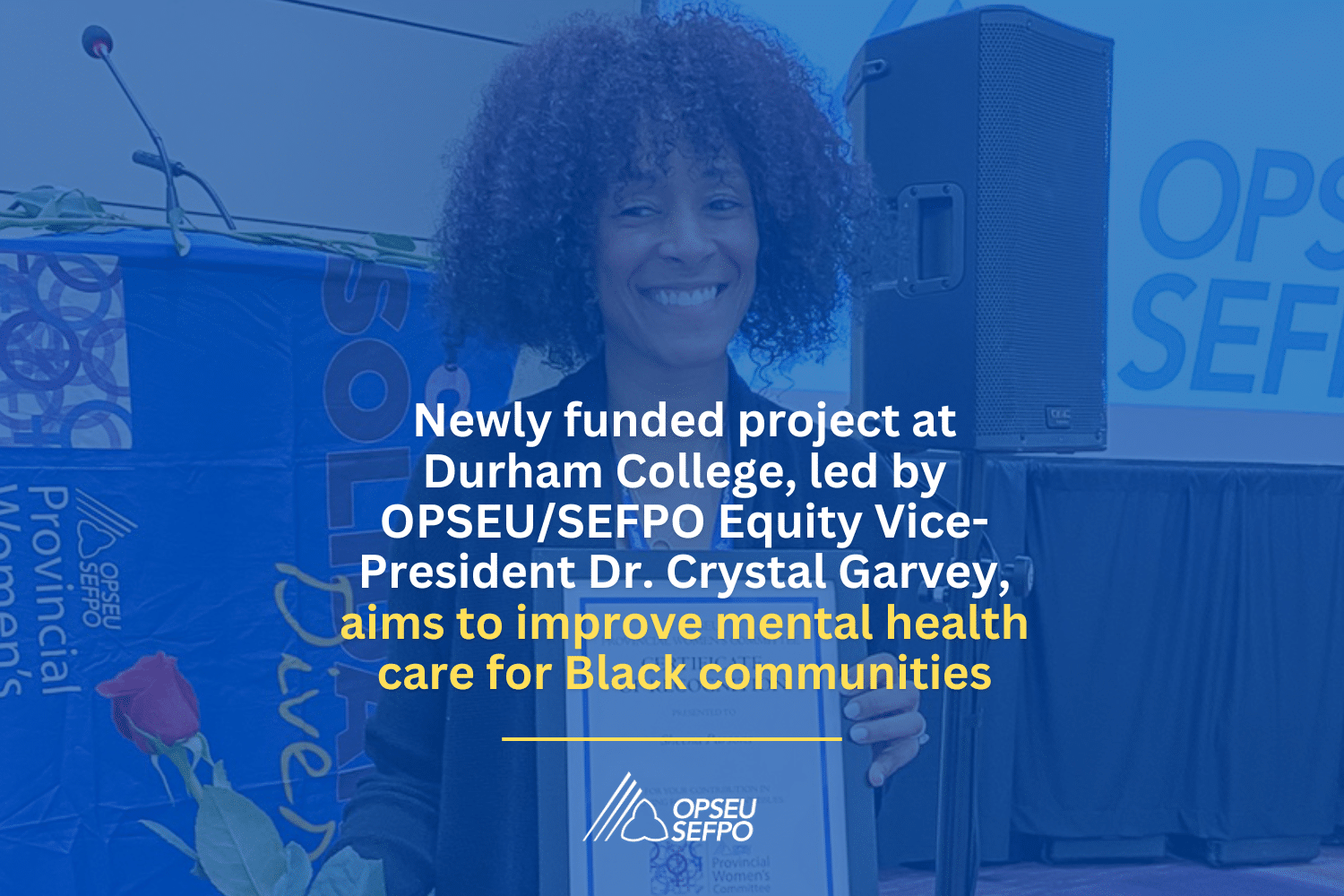
  • Newly funded project at Durham College, led by OPSEU/SEFPO Equity Vice-President Dr. Crystal Garvey, aims to improve mental health care for Black communities

    Newly funded project at Durham College, led by OPSEU/SEFPO Equity Vice-President Dr. Crystal Garvey, aims to improve mental health care for Black communities

    A new project being launched at Durham College’s Social Impact Hub focuses on studying and improving mental health care for Black communities, funded by a freshly announced federal grant of $360,000 under the College and Community Innovation (CCI) program.

    Lead researcher on the project, Dr. Crystal Garvey, is a Durham College faculty member as well as an OPSEU/SEFPO Equity Board Member and the OPSEU/SEFPO Equity Vice-President, sitting on the Provincial Women’s Committee.

    The project will partner the Social Impact Hub with the Health Research Council for People of African Descent, the Regional Municipality of Durham, Black Health Alliance and Ontario Shores Centre for Mental Health Sciences.

    Garvey speaks to the importance of this work, saying, “Historically, when decisions are being made for members of the community who have to access the healthcare system, they’re made by leaders and experts who are not representative of the groups they are serving or making decisions for. What makes this research different is that it is a co-creation piece, where those who actually use the services and are navigating the system will now have a say in what bridging the gaps look like.”

    “I hope that we can be the community that breaks down barriers and makes sure that mental health care is being received equitably and fairly,” Garvey added. “This research, in collaboration with community support and involvement, is going to change the status quo and belief systems associated with mental health…I say with all confidence that it’s going to be a game changer.”

    Read more in the project announcement here.