dev-os

dev enviro for os

  • Sector 18 Mental Health & Addictions Bargaining Conference

    Sector 18 Mental Health & Addictions Bargaining Conference

    The leadership of the OPSEU/SEFPO Mental Health and Addictions Division would like to invite you to participate in our Bargaining conference

    Date(s):

    • Wednesday October 2, 2024, 9 am – 5 pm
      Thursday, October 3, 2024, 9 am – 5 pm

    Hotel:

    • Chelsea Hotel Toronto 33 Gerrard St W, Toronto, Ontario, M5G 1Z4
    • Single rate: $259.00 +taxes
      • Note: valet parking receipts are not a reimbursable claim.

    Meeting Room:

    • Carlyle Room

    Registration:

    • Monday, October 2, 2024, 8:00 am – 9:00 am

    Please note: This is a hybrid event. If you elect to attend virtually, one week prior to the event a Zoom link with instructions will be sent to you. No expenses outside of time off (if required) will be reimbursed unless otherwise pre-approved. Meals for virtual participants are not covered.

    To inquire about pre-approval, please email conferencesandtravel@opseu.org.

    Delegate Entitlement

    All bargaining units in the Mental Health and Addictions Division are invited and are encouraged to attend. Each bargaining unit is entitled to send two (2) Delegate. The President of the Member Local or the highest-ranking officer in the Member Unit will be the automatic first delegate. The locals can select delegates if a general membership meeting is not being held prior to the deadline. It is recommended that delegates selected to attend the conference are members of the bargaining unit’s negotiating committee, if applicable. Alternates may attend at the expense of the local.

    In accordance with the OPSEU/SEFPO Policy Manual (Section 4.2), any member who resides further than 60 kilometers from the event may request that OPSEU/SEFPO make their hotel reservation on their behalf by completing the Hotel Registration section when registering for the event in the OPSEU/SEFPO Member Portal.

    OPSEU/SEFPO will be booking all hotel rooms centrally. Delegates will be reimbursed for single room hotel accommodation.
    Members are also responsible for payment of their hotel room upon check out as there are no charges billed back to OPSEU/SEFPO. Please save your itemized receipt and submit it with your Membership Expense Claim Form.

    Please also notify the Conferences Unit of any special accessibility needs that you may have with respect to your hotel room.

    Any additional nights outside of this policy must be pre-approved by the Conferences Unit, regardless of Region or distance from the event.

    Credential Attestation Form

    The OPSEU Policy Manual (Section 16.1) states that credentials must be submitted with the signatures of two (2) Local Officers on the Credential Attestation Form. We have provided one form for you to list all attendees on.

    Please send this completed form to the Conferences Unit at conferencesandtravel@opseu.org no later than Monday, September 15, 2024. Please clearly identify your status on the form (i.e. Delegate/Alternate /Observer/EBM).

    Late registration forms will be accepted, but late registration isn’t guaranteed.

    Please clearly identify your status, i.e. Delegate/Alternate/Observer.

    Note: other required forms cannot be processed until this form is received.

    Hotel Room Bookings

    In accordance with the OPSEU/SEFPO Policy Manual (Section 4.2), any member who resides further than 60 kilometers from the event may request that OPSEU/SEFPO make their hotel reservation on their behalf by completing the Hotel Registration section when registering for the event in the OPSEU/SEFPO Member Portal.

    OPSEU/SEFPO will be booking all hotel rooms centrally. Delegates will be reimbursed for single room hotel accommodation.

    Members are also responsible for payment of their hotel room upon check out as there are no charges billed back to OPSEU/SEFPO. Please save your itemized receipt and submit it with your Membership Expense Claim Form.

    Please also notify the Conferences Unit of any special accessibility needs that you may have with respect to your hotel room.

    Any additional nights outside of this policy must be pre-approved by the Conferences Unit, regardless of Region or distance from the event.

    OPSEU/SEFPO Travel Policy

    As per OPSEU/SEFPO policy (Section 4.2 7.1), the most economical means of transportation should be used. All delegates are to make their own travel arrangements. As per OPSEU/SEFPO policy, you are directed to use unionized providers where available.

    Please note all Membership Expense Claim submissions require itemized receipts.

    Human Rights Accommodation Request Form

    Should you require a human rights accommodation or have an existing accommodation under the Human Rights Code, please complete and submit the Human Rights Accommodation Request Form in full.

    Family, Dependent and Attendant Care are covered expenses for this event for those who require it at the event or at home.

    OPSEU/SEFPO Child Care Policy

    OPSEU/SEFPO undertakes to provide childcare services, when requested, at all union educationals, conventions, regional, divisional, and demand-setting meetings where the membership requests at least three weeks prior to the event. Members who bring their children to OPSEU/SEFPO sponsored functions should normally be required to use the on- site childcare service if it is available. The three-week notice will ensure adequate time to process advances when requested. If no requests for on-site childcare are received three weeks prior to the activity date, childcare arrangements for on-site childcare may not be made.

    If members then bring children to the event without the required notice, the member should be responsible for making his/her own childcare arrangements.

    Procedures for Online Submission of Forms

    Members are to complete their Event Registration, Hotel Booking and Child Care Registration through OPSEU/SEFPO’s Member Portal.

    Forms

    1. Credential Attestation Form
    2. Advance Form
    3. OPSEU/SEFPO Human Rights Accommodation Form
    4. Local that wish to use rebates for time off for alternates and observers Form
    5. Complete Online Survey: https://forms.office.com/r/wuizYec5DT

    In order to confirm your registration, please submit all forms by email to the Conferences Unit (conferencesandtravel@opseu.org) no later than Monday September 15, 2024. Late registration forms will be accepted, but late registration isn’t guaranteed.

    We appreciate your participation in these meetings.

    In Solidarity, Authorized for Distribution:

    Ed Arvelin
    Divisional Chair  Sector 18 – Mental Health & Addictions

    J.P. Hornick
    OPSEU/SEFPO President
  • United for a decent pension plan: Staff at SickKids rally for same deal as other Ontario hospital workers

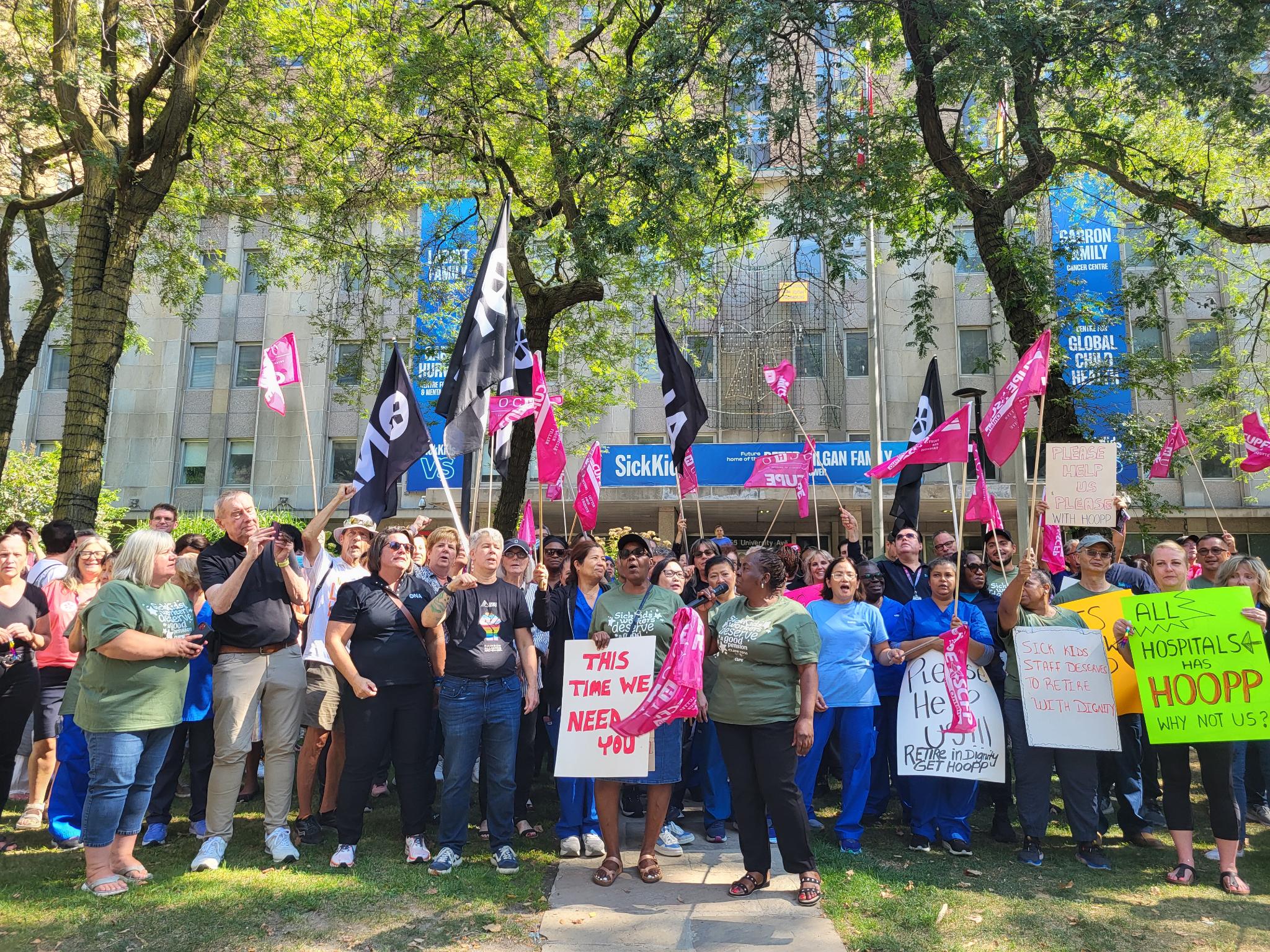
    United for a decent pension plan: Staff at SickKids rally for same deal as other Ontario hospital workers

    Staff at SickKids Hospital in Toronto organized a demonstration today, calling on the employer to join the Healthcare of Ontario Pension Plan, HOOPP. The call comes after workers became aware that their current pension will leave them retiring in poverty because the employer failed to contribute to the plan for decades.

    “This hospital built its reputation as a world-class institution on the strength of the contribution of these women. SickKids must ensure its staff don’t retire into poverty,” says Michael Hurley, president of CUPE’s Ontario Council of Hospital Unions, OCHU-CUPE.

    SickKids is set to become the only hospital in Ontario whose employees are not part of HOOPP, which has more than 460,000 health care workers in the plan.

    The group of workers including nurses, patient service aides, clerical staff, lab technicians and others wants their employer to give them the pension plan they deserve. According to the workers, HOOPP is far superior to the SickKids’ staff pension plan. A worker earning $45,000 at the end of their career with 30 years of service can expect to receive annual payments of $25,560 through HOOPP, about $8,000 more than their current plan.

    “The Ontario Nurses’ Association and our 68,000 members are in solidarity with SickKids workers fighting for a decent pension and retirement security. After taking care of our most vulnerable community members, health-care workers deserve to retire with dignity. SickKids and the board of directors have a responsibility to ensure that,” said Erin Ariss, registered nurse and ONA provincial president.

    Leonora Foster, a patient service aide and president of CUPE 2816, which represents about 670 staff at the hospital, says that she and her colleagues have repeatedly brought up the pension issue, but hospital management is resistant to change.

    “For years now, we have been calling on SickKids to do the right thing and join HOOPP,” Foster said. “HOOPP is a superior pension plan that offers workers a dignified retirement. Other hospitals provide it, and there is absolutely no reason for SickKids to stick to its own poverty-inducing pension plan. All the workers here are united in our fight for a decent pension plan, and that means SickKids must join HOOPP.”

    Based on research done by the unions, SickKids has been on a “pension holiday” as it has not made contributions to the pension plan for 25 out of the last 27 years.

    “SickKids staff dedicate their lives to supporting our most vulnerable children, and they deserve real financial security in their retirement. SickKids must take these workers’ futures seriously by joining the HOOPP pension plan. We will stand together and demand it!” said JP Hornick, president of OPSEU.

  • Region 2 Dismantling Systemic Racism Program Training – Oct 21 or Oct 23

    Region 2 Dismantling Systemic Racism Program Training – Oct 21 or Oct 23

    We are very excited that two sessions of the one-day training, “Organizing for Power: Dismantling Anti-Black, Anti-Indigenous, and All Forms of Racism”, will be held in Region 2 for all OPSEU/SEFPO elected leaders including Stewards, Bargaining Team Members, and Health and Safety Representatives. The two sessions are taking place:

    • Monday, October 21, 2024 (9am–5pm) – Guelph Regional Office Membership Center (400 Speedvale Ave W, Guelph)
      • or
    • Wednesday, October 23, 2024 (9am-5pm) – Hamilton Regional Office Boardroom (505 York Blvd, 2nd Floor, Hamilton)

    As per the OPSEU/SEFPO Constitutional Amendment, Article 7 of the Constitution requires mandatory training for elected leaders and bargaining teams, on dismantling racism. The goal of OPSEU/SEFPO is: To actively identify and dismantle anti-Black racism, anti-Indigenous racism and all forms of racism and discrimination within its systems and structures so that all members have full access to services and can fully participate in the Union.

    Please organize your Local or committee (50 per cent of members), complete the registration form, and let your Staff Representative know. Please attach an additional sheet if required.

    Please send completed registration forms by email to lhills@opseu.org or by fax to 519-837-9187 by Friday, October 4, 2024.

    Expenses

    Participants must be registered on the OPSEU/SEFPO Member Portal before submitting an expense claim: members.opseu.org. To submit an expense claim log onto the OPSEU/SEFPO Member Portal no sooner than 48-hours following the session.

    Member Portal Tutorials:

    Employer Wage Reimbursement

    Wages for members attending DSRP Training are OPSEU/SEFPO reimbursed. If you require time off to attend the session, please ensure your Employer & Supervisor’s Name, Address, and Email are included on the Registration Form. Time off request letters will be emailed to employers by Monday, October 7, 2024. You will be copied on the email.

    Travel Expenses & Mileage Rates (Per OPSEU/SEFPO Policy Manual, Section 4.2.7.1)

    The most economical means of transportation should be used. Members are responsible for making their own travel arrangements. As per OPSEU/SEFPO policy, you are directed to use unionized providers where available. Please note all Membership Expense Claim submissions require itemized receipts.

    • 60 cents/km if driving alone;
    • 65 cents/km if driving with one OPSEU/SEFPO member as a passenger;
    • 70 cents/km if driving with 2 OPSEU/SEFPO members as passengers;
    • 75 cents/km if driving with 3 OPSEU/SEFPO members as passengers;
    • 80 cents/km if driving with 4 OPSEU/SEFPO members as passengers.

    Meals

    Coffee/tea/water will be provided and members will be responsible for purchasing their own lunch. The current lunch reimbursement rate is $30. Receipts are not required for meal claims.

    Parking

    Parking is free at both the Guelph and Hamilton Regional Offices.

    Hotel Accommodation (Per OPSEU/SEFPO Policy Manual, Section 4.2)

    • Members who live further than 60 km from the session location are entitled to overnight accommodation the night prior to the session in which they are registered.
    • Members who live within 60 km of the session location are not eligible for overnight accommodation.

    Members are responsible for handling their own reservations/cancellations and for paying the full cost of the room and any associated parking costs upon checkout. As per OPSEU/SEFPO policy, you are directed to use unionized providers where available. Please note all Membership Expense Claim submissions require itemized receipts.

    Suggested Hotels:

    Human Rights Accommodation Request Form

    • The Accommodation Fund was created to encourage and facilitate greater participation of those covered under the Ontario Human Rights Code. The Fund will cover extra costs related to a member’s disability, illness, or other grounds under the Code. For example, the Fund would cover the extra cost of a fridge in a hotel room for a member required to store medications at a particular temperature.
    • Requests should be submitted by using the Human Rights Accommodation Request Form. Please submit the form directly to lhills@opseu.org by October 4, 2024.

    Advance Request Form

    Registrants may apply to receive an advance (via direct deposit or cheque) to cover approved expenses by filling out the Advance Request Form and sending it directly to advances@opseu.org.

    Forms


  • No Space for Hate in Ontario! Province-wide action to protect trans kids on Friday, September 20

    No Space for Hate in Ontario!  Province-wide action to protect trans kids on Friday, September 20

    OPSEU/SEFPO is calling on our members and friends to once again show up for the 2SLGBTQ+ community this Friday, September 20th to counter insidious misinformation and hate with a message of radical love and acceptance.

    One year ago, OPSEU/SEFPO joined the Ontario Federation of Labour and thousands of allies across the country in supporting counter protests challenging the hateful rhetoric of a group targeting 2SLGBTQ+ children and their families.

    Find a counter-protest in your community: look for your city on this list from 1 Million Voices for Inclusion.

    This hateful movement once again plans to threaten the safety of our communities and the well-being of transgender children and youth. Their goal is nothing other than to intimidate and instill fear in us, to mislead Canadians, and to make Canada less safe for Queer and transgender people of all ages.

    We will not be intimidated. We will never stop standing in solidarity with our Queer and transgender members, children, families, and communities. Wherever and whenever hateful movements rise up in our country, OPSEU/SEFPO and the labour movement will be there to challenge them.

    Together, we outnumbered the so-called ‘one million’ hateful protestors in almost every city; this year will be no different.

    In solidarity,
    OPSEU/SEFPO Rainbow Alliance Arc-en-Ciel


    Resources
    1. GSA Network. Safety Tips for LGBTQ+ Youth.
    2. The Movement Defence Committee (MDC). Know Your Rights: A guide for activists.
    3. Eastern Michigan University. Event Safety & Planning Checklist.
    4. Egale Canada and Fierte Canada Pride. Pride Safety Toolkit.
    5. Kids Help Phone.
    6. Canadian Anti-Hate Network: Guide for Pride Defenders / Abridged version.
    7. Canadian Anti-Hate Network: Confronting and Preventing Hate in Canadian Schools.
  • Conciliation & Strike Mandate Vote: Holding the CEC to Account

    Conciliation & Strike Mandate Vote: Holding the CEC to Account

    Bargaining Bulletin 8

    Highlights:

    • The employer continues to show a lack of serious engagement with Faculty proposals, instead choosing the path of delays.
    • Our collective agreement expires in less than two weeks.
    • The CEC has tabled concessions in their proposals that will negatively impact Faculty working conditions.
    • In the spirit of our commitment to negotiating an on-time, renewal agreement, we are filing for conciliation and strike mandate vote to increase accountability to the process.
    • You can read through our Conciliation & Strike Mandate Vote FAQs here.
    • We call on the CEC and the Colleges to drop the delay tactics and bargain members’ demands fairly with our remaining scheduled dates.

    As of today, we have completed fourteen (14) days of bargaining with the CEC and the Colleges.

    While we have maintained our goal of negotiating an on-time, renewal collective agreement that meets members’ demands, the College Employer Council (CEC) and the Colleges continue to draw from a decades-old playbook of delay tactics.

    With our collective agreement expiring at the end of the month, the employer is counting on the commotion of the fall semester starting up to distract members’ attention away from bargaining. We can see the employer responding slowly, making the inflated claim last week that our non-monetary proposals would cost $1 billion annually to the Colleges system-wide, without costing or useful data to back up the claim – a thinly-veiled attempt to divide workers and undermine support for faculty proposals at on table.

    On the faculty side, we’re moving quite differently – we want to maximize member awareness and engagement during bargaining. For one, it builds power behind our proposals. This transparency also honours a key principle: democratizing the process. Bargaining is our democratic, Charter-protected right and our one opportunity every few years to collectively improve wages and working conditions. 

    Given the tasks before us – combatting employer delays and a general lack of accountability, democratizing the bargaining process, and leveraging our collective power to compel the CEC and Colleges to weigh our proposals seriously – we are moving forward with filing for Conciliation and a strike mandate vote.

    You can read through our Conciliation & Strike Mandate Vote FAQ here.

    Charting the path forward: why Conciliation?

    “Conciliation” occurs when one or both Parties believe that they have reached an impasse and require assistance reaching an agreement from a government-appointed Conciliation Officer. At this point, we have not seen a willingness from the employer to take Faculty proposals seriously, and our collective agreement expires in less than two weeks.

    A Conciliation Officer helps the parties try to work through the impasse and reach a settlement, but they cannot force the Parties to come to an agreement or make decisions about what proposals will form the Collective Agreement. The Parties are required to participate in Conciliation prior to either party triggering a strike or lockout.

    Conciliation is a tool that can help move the parties forward – but to be successful in moving on our key priorities, we need to enter conciliation with a high-participation, strong strike mandate as a demonstration of member support. A Conciliation Officer will help the parties to work to a fair resolution, but they need to know – as does the employer – that the membership is behind their bargaining team. 

    Cutting through the noise: what to expect from the CEC?

    Our proposals are based on your member demands. Not only are they reasonable, but they are grounded in data requested by the CEC and the Colleges, mandated by Arbitrator Kaplan to inform bargaining this round. Faculty proposals aim to improve the College system for all: for students first and foremost, for workers in this system, and for the communities our Colleges serve.

    The CEC and the Colleges will likely communicate that our decision to file for Conciliation is an “escalation.” However, Conciliation is a normal step in negotiations. Particularly given where we are in the process, Conciliation and a strike mandate vote are appropriate and necessary steps.

    At the bargaining table, both sides have made commitments to getting a deal done – yet the proposals we have received from the CEC so far contain several concessions that will make members’ working lives worse. To name three (3) glaring examples:

    • eliminating five (5) consecutive days of professional development;
    • attempting to circumvent the partial load registry with a probationary period;
    • undermining academic freedom by removing faculty oversight from the work of instructors.

    We are not bargaining for a strike, but neither do we bargain backwards. Concessions are unacceptable at the table – filing for conciliation and a strike mandate vote is how we hold the CEC to account and test the integrity of their commitment to these negotiations.

    We are asking the CEC and the Colleges to drop the delay tactics, bargain members’ demands fairly with our remaining scheduled dates, and negotiate a collective agreement that makes material gains for members who are training Ontario’s future. 

    Stay Informed, Stay Engaged, Get Involved

    You can stay up to date with the bargaining team and developments at the bargaining table in several ways:

    In solidarity,

    Your CAAT-A Bargaining Team:

    Ravi Ramkissoonsingh, L242, Chair (he/him)
    Michelle Arbour, L125, Vice-Chair (she/her)
    Chad Croteau, L110 (he/him)
    Bob Delaney, L237 (he/him)
    Martin Lee, L415 (he/him)
    Sean Lougheed, L657 (he/him)
    Rebecca Ward, L732 (she/her)

  • College Faculty conciliation and strike mandate vote FAQs

    College Faculty conciliation and strike mandate vote FAQs

    Printable PDF

    What is “conciliation”?

    “Conciliation” occurs when one or both bargaining parties believe that a third party can move negotiations forward. At any point during negotiations, Ontario’s Colleges Collective Bargaining Act (CCBA) allows OPSEU/SEFPO or the College Employer Council (CEC) to request neutral third-party assistance to help resolve their differences. A request for conciliation is a common occurrence during collective bargaining.

    After the request for conciliation is filed, a Conciliation Officer is appointed by the Minister of Labour to meet with the union and the employer to try and help the parties work through an impasse and reach a settlement.

    Review the CCBA here.

    What does a Conciliation Officer do?

    A Conciliation Officer (or “Conciliator”) is an impartial third party, appointed by the Minister of Labour, who has experience in mediation and alternative dispute resolution.

    Conciliation Officers confer with both the union and the employer, using their expertise to try to help both sides find mutually agreeable solutions to outstanding issues they might not have considered during bargaining.

    What is a “no board” report, and what happens in the “no board” process?

    The Conciliation Officer reports the outcome of the conciliation meeting to the Minister of Labour. If the parties still cannot reach an agreement, the Minister of Labour will issue a written notice – known as a “no board report” – to OPSEU/SEFPO and the CEC bargaining agencies stating that a conciliation board will not be appointed.

    Employer-imposed terms and conditions of employment are legally possible on the 17th day following the issuance of this “no board” report – at which point we are also in a legal strike position.

    The two sides can keep trying to reach a deal before or after a “no board” report has been issued by the Minister of Labour.

    What does the Colleges Collective Bargaining Act say about “no board” reports?

    Ontario’s Colleges Collective Bargaining Act states that the existing terms and conditions of collective agreements remain the same until the Ministry of Labour issues a “no board” report.

    After the “no board” report is issued, the terms and condition of a collective agreement are frozen for a 16-day period. Bargaining may continue during that time. On the 17th day following the “no board” report, any or all of the following could legally occur:

    • we can call for strike action provided we taken a strike vote and more than 50% vote in favour of strike action (Note: strike action can range from work-to-rule up to a full withdrawal of services);
    • the employer could lock out its employees;
    • the employer could make unilateral changes to the collective agreement;
    • we can continue to bargain with the employer;
    • we can mutually agree with the employer to send unresolved issues to binding arbitration;
    • the employer still has the option of requesting a final offer – or “forced” offer – vote.

    How long does it take for a Conciliator to send a “no board” report to the Minister of Labour?

    It varies, but typically it takes a week.

    What can the employer do by requesting the “no board” report?

    On the 17th day after the “no board” report has been issued, the CEC can either lock faculty out or impose terms. Under the CCBA, both parties are required to provide five (5) days notice before commencing a labour action (including a lockout or strike.)

    What are these “imposed terms” you are referring to?

    “Imposed terms” are a nuclear option available to the CEC. On the 17th day after the “no board” report has been issued, the CEC can unilaterally change faculty’s pay, benefits, or any other working condition. The terms could be absolutely anything.

    Why do we need a strike mandate?

    Conciliation is a tool that can help move the parties forward – but to be successful in moving on our key priorities, we need to enter conciliation with a high-participation, strong strike mandate as a demonstration of member support. A Conciliation Officer will help the parties to work to a fair resolution, but they need to know – as does the employer – that the membership is behind their bargaining team.

    In addition, we need a strike mandate before engaging in any job action such as work-to-rule or a strike. A strike mandate is something you want to have as a possible response to employer-imposed terms.

    If we have a strike mandate, do we have to engage in strike action on the 17th day after the Minister of Labour issues a “no board” report?

    No, we do not have to – with a strike mandate in hand, we can call for a strike action at any time following the 17th day after a “no board” is issued. A strike is a last resort for leverage to achieve member demands and improve our collective working conditions. We want to be able to respond to the nuclear threat of imposed terms should the employer use them.

    The decision to go on strike comes from the membership – these are your contracts that are being negotiated, and you get to decide whether what’s being offered is good enough. A strike mandate vote gives us leverage at the table by legitimizing the credible threat of our strongest leverage tools.

    Under the CCBA, both parties are required to provide five (5) days notice before commencing a labour action (including a lockout or strike.)

    Once the “no board” report has been issued, can we continue to bargain?

    Yes! There is nothing that prevents either party from continuing to bargain. In fact, this would be preferable as it means both parties are working towards a mutually agreeable negotiated settlement.

  • Part-Time Support Staff Bargaining Update: We Deserve More in 2024

    Part-Time Support Staff Bargaining Update: We Deserve More in 2024

    Bargaining Bulletin #6:

    On September 11, 2024, your College Support Staff Part-Time Bargaining Team was back at the table with the Employer. Five months after presenting our original monetary proposal, we finally received a written response from the employer’s team. While we are happy to see movement at the table an indication of the employer’s desire to move forward – some of their proposals continue to fall short of key priorities.

    We were particularly surprised to see language tabled that would be detrimental to student workers, especially after many months of conversations about the significance of student work at the Colleges. Since our first meeting with the employer in January, we have emphasized the importance of better pay for minimum wage workers – yet based on the employer’s proposal, their vision for workers appears to be the opposite.

    We know part-timers are eager to hear news on paid sick days. The employer’s latest proposal clearly ignores the extensive conversations that have taken place across Ontario around the importance of sick days for all college employees. Over the last several months, the Bargaining Team traveled to meet part-timers across the province. At every College, we’ve heard directly from you on the importance of paid sick days.

    Illness does not discriminate based on classification. Part-timers deserve paid sick days, instead of losing pay and falling further behind on the cost of living. Years after a global pandemic, we can’t afford to wait. Paid sick days for all part-time support staff, not only regular part-time (RPT) classifications, remains a key priority.

    Throughout the bargaining process, we have continued to emphasize the importance of making meaningful changes to Equity, Diversity, and Inclusion language, including changes to Bereavement Leave language to include “chosen family,” and adding a new article on Religious/Cultural Leave which would allow support staff from all religions and cultures to celebrate their holidays.

    These changes, significant to members across the province, would not come at a significant cost or burden to the employer. All the same, we’ve received immense pushback on even these reasonable proposals – displaying a lack of commitment to EDI on the employer’s part, despite all Colleges naming EDI and Indigenisation as priority areas in their Strategic Plans. Workers need meaningful action, not just platitudes: our proposals are an opportunity for the Colleges to put their EDI priorities in practice.

    Your Bargaining Team is busy discussing next steps for this bargaining round – watch your email for more details, which we will share with you as soon as available.

    As always, if you have any questions or concerns about bargaining, you can email caatsptbargainingteam@gmail.com.

    In solidarity,

    Your College Support Part-Time Bargaining Team:

    Noor Askandar, George Brown College, Chair

    Sara McArthur, Mohawk College, Vice-Chair

    Doreen Follett, Algonquin College, Member

    Torsten Hamelin, George Brown College, Member

    Aliza Kassam, George Brown College, Member

    Paula Naylor, Sault College, Member

    Natalie Williams, Sheridan College, Member

    We want to hear from you about benefits!

    Reminder: If you have yet to complete the benefits survey, please do so at this link.

    Follow us on social media for regular updates:

    Instagram: @CollegeSupportPT Facebook: @CollegeSupportPT

    #MoreThanMinimum #NotaSideHustle #CollegesRunOnPTpower

  • Table Talk – OPS Unified understanding Area Coordinating Groups

    Table Talk – OPS Unified understanding Area Coordinating Groups

    Essential and Emergency Services

    Negotiations remain ongoing with the employer and under the Crown Employees Collective Bargaining Act (CECBA) OPSEU/SEFPO members in the Ontario Public Service (OPS) have the legal right to strike. However, during this process it also requires OPS Unified to provide essential and emergency services during a strike or employer lockout.’

    Excerpts of the CECBA related to essential and emergency service plans are included below.

    How does this impact OPS Unified Bargaining?

    The OPS Unified Bargaining team is now gathering information from the membership to effectively negotiate new Essential and Emergency Services Agreement(s) (EESA) with the employer

    Important links

    Frequently asked questions

    Frequently Asked Questions

    Distinction between EES Form and EESA?

    Essential and Emergency Services (EES) are services necessary for the safety and/or security of the public. EES Forms are documents completed by locals to assist the Bargaining Team in negotiating the Agreements.

    Essential and Emergency Services Agreements (EESAs) are any signed documents negotiated between the union and employer to provide the above services.

    Doesn’t the union already have the Essential and Emergency Service Agreements (EESA’s) from previous rounds of bargaining?

    All previous agreements are null and void and therefore new ones need to be negotiated.

    Who decides what duties and which members will be essential?

    Your Bargaining Team and the employer negotiate essential services in accordance with CECBA.

    What can I do?

    • Keep informed by reading OPS Unified communications
    • Join your regional Area Coordinating Groups (ACG) on the Signal app
    • Assist with completing local EES forms as requested
    • Attend zoom sessions with the Bargaining Team as scheduled
    • Update your personal information on OPSEU/SEFPO member portal.

    CECBA Section 30

    “Essential services” means services that are necessary to enable the employer to prevent,

    1. danger to life, health or safety,
    2. the destruction or serious deterioration of machinery, equipment or premises,
    3. serious environmental damage, or
    4. disruption of the administration of the courts or of legislative drafting; (“services essentiels”)

    An “Essential services agreement” is an agreement between the employer and trade union that applies during a strike or lock-out and that has,

    1. an essential services part that provides for the use, during a strike or lock-out, of employees in the bargaining unit to provide essential services, and
    2. an emergency services part that provides for the use, during a strike or lock-out, of employees in the bargaining unit, in addition to those referred to in clause (a), in emergencies. (“entente sur les services essentiels”) 1993, c. 38, s. 30.

    Call to action

    Contact your local!

    Complete and submit your EES forms by Friday, Sept. 13 to UnifiedOPSBargaining@opseu.org

    Join us

    We want to hear from you!!!

    Join the Table Talk Thursdays conversations every third Thursday on Zoom.

    Fun and games

    I bring together parts to form a whole, In a team or a bond, I play my role. Strong when united, weak when apart, What am I, connecting heart to heart?

    In Solidarity,

    On behalf of the OPS Unified Bargaining team:
    Amanda Usher — Chair
    Leslie Aiston — Vice Chair

  • Table Talk – OPS Unified understanding Area Coordinating Groups

    Table Talk – OPS Unified understanding Area Coordinating Groups

    Area Coordinating Group (ACGs)

    ACGs are a key part of the bargaining process. They are a direct line of communication between OPS Unified members and the Bargaining Team. As we continue to build our bargaining power, our unity is our strength. All OPS Unified members are encouraged to join.

    In November 2022, the OPS Unified Collective Bargaining Negotiations Procedures were revised and then approved by the OPSEU/SEFPO Executive Board in July 2023. The updated Procedures Manual can be found in your member portal, and a link is also available under “Important Links.” The OPS Unified Bargaining Procedures are laid out in the Procedures Manual under Article 3.2, subsection 6B.  

    Section 2 discusses “Roles and Structures.” In addition to the Bargaining Team, section 2.8 highlights the creation and usage of “Area Coordinating Groups” (ACGs). 

    Important links

    Frequently asked questions

    Frequently Asked Questions

    Who is on the ACG? 

    • OPS Unified Local Presidents or designees
    • Bargaining team alternates
    • Bargaining team members after new agreement has been ratified
    • Executive Board Members
    • OPSEU/SEFPO Staff

    ACGs will operate during all phases of the bargaining cycle.

    Duties and Responsibilites of the Area Coordinating Group (ACG)

    • Elect Chair & Vice Chair 
    • Organize meetings at least quarterly
    • Generate minutes of meetings and ensure minutes are sent to: UnifiedOPSBargaining@opseu.org
    • OPS demand set survey input
    • Training
    • Communicate with membership / Discuss current issues
    • Organizing/Mobilizing activities, events and ideas
    • Emergency Essential Service Agreements information and support 
    • Provide Local support
    • Locals forward their demands/enforcement issues to ACG
    • Meet with elected regional bargaining team rep & mobilizers 
    • Other tasks as required 

    All OPS Unified members are invited to join their Regional ACG. Please join the chats hosted on the Signal app. This link will provide you with QR codes for each regional chat.

    Phase 1 Demand Set Survey 

    The ACG chairs across the province took the initiative to create a Phase 1 survey. 

    This first phase involves a comprehensive survey designed to gather specific and detailed information. The data gathered will be crucial in shaping, influencing, mobilizing and providing vital information to the Bargaining Team. This is an excellent venue for you to shape the Phase 2 Demand Set issues and provide critical information to the Bargaining Team. 

    Link to the Phase 1 ACG survey.

    Call to action

    Hurry! Time is running out to submit the Essential and Emergency Services Forms.


    YOUR TO-DO LIST:

    COMPLETE THE ESSENTIAL AND EMERGENCY SERVICES FORMS ARE ALREADY

    PAST DUE. [SEPTEMBER 13TH 2024]

    We need your Essential and Emergency Service forms.

    We continue to support our teams and locals, so reach out if you need help getting these done. You don’t have to take this all on yourself. Canvass your site leads and engage your stewards to assist you. Once completed, please return them to unifiedopsbargaining@opseu.org.

    DON’T BE SHY – WE WANT TO HEAR FROM YOU – QUESTIONS CAN BE SUBMITTED TO: unifiedopsbargaining@opseu.org.

    It’s important to start the discussions at your local meetings. We can schedule a time to discuss the EES forms with you and your stewards or members.

    Join us

    WHO: The bargaining team would like to invite Unified members to Table Talk Thursdays.

    WHAT IS TABLE TALK THURSDAYS: Table Talk Thursdays are Zoom sessions where YOUR bargaining team shares updates and insights with union members about ongoing negotiations and activities. Join us to stay informed and engaged with the latest news and developments.

    WHERE: It happens over ZOOM.

    WHEN: This happens every third Thursday of the month from 7 pm to 8 pm EST (6 pm CST).

    The next session will be September 19th, 2024

    WHY: To keep the lines of communication open!

    Fun and games

    1) Why did the union organizer always bring a ladder to meetings?

    Because they were always looking to help their members reach new heights!

    2) Why did the worker union start a gardening club?

    To help their members grow together!

    In Solidarity,

    On behalf of the OPS Unified Bargaining team:
    Amanda Usher — Chair
    Leslie Aiston — Vice Chair

    Issue 5


  • Table Talk – OPS Unified gathering info for bargaining

    Table Talk – OPS Unified gathering info for bargaining

    Essential and Emergency Services

    Negotiations remain ongoing with the employer and under the Crown Employees Collective Bargaining Act (CECBA) OPSEU/SEFPO members in the Ontario Public Service (OPS) have the legal right to strike. However, during this process it also requires OPS Unified to provide essential and emergency services during a strike or employer lockout.’

    Excerpts of the CECBA related to essential and emergency service plans are included below. 

    How does this impact OPS Unified Bargaining?

    The OPS Unified Bargaining team is now gathering information from the membership to effectively negotiate new Essential and Emergency Services Agreement(s) (EESA) with the employer

    Important links

    Frequently asked questions

    Frequently Asked Questions

    Distinction between EES Form and EESA?

    Essential and Emergency Services (EES) are services necessary for the safety and/or security of the public. EES Forms are documents completed by locals to assist the Bargaining Team in negotiating the Agreements.

    Essential and Emergency Services Agreements (EESAs) are any signed documents negotiated between the union and employer to provide the above services.

    Doesn’t the union already have the Essential and Emergency Service Agreements (EESA’s) from previous rounds of bargaining?

    All previous agreements are null and void and therefore new ones need to be negotiated.

    Who decides what duties and which members will be essential?

    Your Bargaining Team and the employer negotiate essential services in accordance with CECBA.

    What can I do?

    • Keep informed by reading OPS Unified communications
    • Join your regional Area Coordinating Groups (ACG) on the Signal app
    • Assist with completing local EES forms as requested
    • Attend zoom sessions with the Bargaining Team as scheduled
    • Update your personal information on OPSEU/SEFPO member portal.

    CECBA Section 30

    “Essential services” means services that are necessary to enable the employer to prevent,

    1. danger to life, health or safety,
    2. the destruction or serious deterioration of machinery, equipment or premises,
    3. serious environmental damage, or
    4. disruption of the administration of the courts or of legislative drafting; (“services essentiels”)

    An “Essential services agreement” is an agreement between the employer and trade union that applies during a strike or lock-out and that has,

    1. an essential services part that provides for the use, during a strike or lock-out, of employees in the bargaining unit to provide essential services, and
    2. an emergency services part that provides for the use, during a strike or lock-out, of employees in the bargaining unit, in addition to those referred to in clause (a), in emergencies. (“entente sur les services essentiels”) 1993, c. 38, s. 30.

    Call to action

    Contact your local!

    Complete and submit your EES forms by Friday, Sept. 13 to UnifiedOPSBargaining@opseu.org


    Join us

    We want to hear from you!!!

    Join the Table Talk Thursdays conversations every third Thursday on Zoom.

    Fun and games

    I bring together parts to form a whole, In a team or a bond, I play my role. Strong when united, weak when apart, What am I, connecting heart to heart?

    In Solidarity,

    On behalf of the OPS Unified Bargaining team:
    Amanda Usher — Chair
    Leslie Aiston — Vice Chair


  • Practice your French with Us by Zoom – monthly themes and draw!

    Practice your French with Us by Zoom – monthly themes and draw!

    The Provincial Francophone Committee is delighted to announce the launch of our new Zoom evening series: Practice your French with Us by Zoom !!

    Whether you’re a beginner or advanced, these evenings are designed to help improve your French skills in a relaxed and friendly atmosphere.

    Evening calendar and themes:

    September 25, 2024 @ 7 p.m. – Home Recipes

    • Share your favourite recipes and discover new culinary inspirations. All participants will receive our cookbook!

    Details of the first evening:

    • Title: Practice Your French with Us – first evening
    • Theme: Home Recipes
    • Date: September 25, 2024
    • Time: 7 p.m.

    Please RSVP here, and we’ll send you a Zoom link!